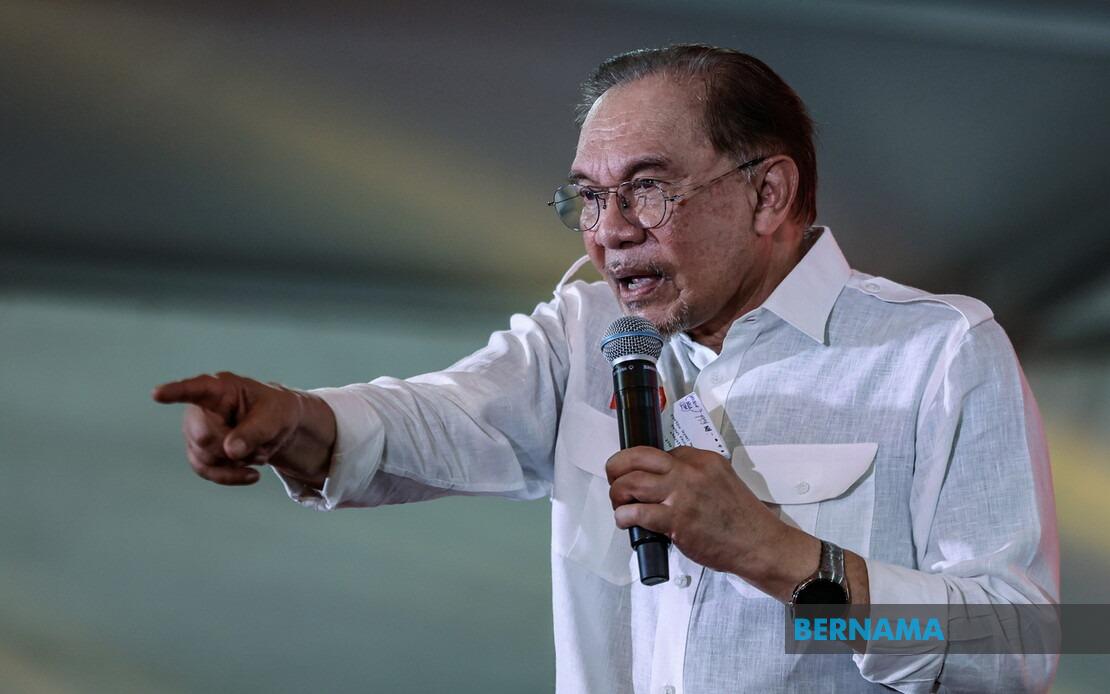
Prime Minister Datuk Seri Anwar Ibrahim expressed frustration on July 10 over what he characterised as unwarranted political attacks from Kedah Menteri Besar Datuk Seri Muhammad Sanusi Md Nor, despite ongoing federal efforts to advance development projects within the northern state. Speaking at a Pakatan Harapan (PH) campaign event in Simpang Renggam, Anwar underscored that his administration maintains a commitment to all Malaysian states and their constituents, regardless of their political complexion or ruling coalition alignment.
The tension between the Prime Minister and the Kedah chief minister reflects a broader pattern of friction between the federal PH-led government and opposition-controlled state administrations. Sanusi, representing the PAS-led Kedah government, has previously suggested that Anwar operates under the assumption that all states depend entirely on Kuala Lumpur for their survival and development—a characterisation Anwar firmly rejected during his campaign remarks. The Prime Minister's defensive posture indicates that such barbs have struck a nerve, particularly given the delicate political calculations ahead of the Johor state election.
Anwar's frustration was particularly acute regarding Sanusi's decision to avoid attending a high-profile official event in Kedah earlier that day. The Prime Minister brought Thai Prime Minister Anutin Charnvirakul to Bukit Kayu Hitam—deliberately choosing a border location rather than staging the bilateral engagement in the capital—to inaugurate a new road alignment connecting the Bukit Kayu Hitam Immigration, Customs, Quarantine and Security (ICQS) Complex with Thailand's corresponding Sadao facility. The deliberate choice of venue underscores federal investment in cross-border infrastructure, yet Sanusi's absence suggests political calculation or protest against the federal government's initiatives.
The infrastructure project being unveiled represents a substantive economic development initiative for both Kedah and the broader northern region. By improving connectivity between Malaysia's ICQS complex and Thailand's immigration and customs operations, the new road alignment aims to streamline border trade and facilitate smoother cross-border movement of goods and people. This directly supports Anwar's stated objective of boosting the border economy, which would theoretically benefit both Perlis and Kedah residents through enhanced commercial opportunities and efficiency gains at one of Southeast Asia's busiest land crossings.
Anwar's rhetorical strategy during his campaign appearance emphasised that partisan considerations do not drive federal resource allocation and development priorities. He articulated a vision of national leadership that transcends factional interests, positioning himself as a leader concerned with serving all Malaysians rather than prioritising states governed by PH allies. This framing attempts to insulate his administration from accusations of playing politics with development, a sensitive issue in Malaysian federalism where resource distribution between Kuala Lumpur and state governments has historically become weaponised by rival coalitions.
The Prime Minister's invocation of his broader responsibilities and Malaysian citizenship provided context for his apparent exasperation with Sanusi's attacks. Anwar suggested that the Kedah chief minister's criticism—voiced while he was in Johor, notably away from his own state—represented a form of political theatre divorced from substantive engagement on development matters. The absence of the Menteri Besar from the Bukit Kayu Hitam event created an optics problem for the Kedah government, potentially conveying to local constituents that their chief minister was unwilling to acknowledge federal-level infrastructure improvements benefiting their region.
Beyond the bilateral infrastructure project, Anwar used the campaign platform to signal the federal government's financial discipline and capacity for enhanced social spending. He announced plans to increase the Sumbangan Asas Rahmah (SARA) assistance programme—a targeted cash transfer scheme benefiting lower-income households—contingent on continued political stability and electoral validation through PH's retention of public support. The framing of potential SARA increases as dependent on governmental stability indirectly reinforced the stakes of the Johor election occurring the following day, where PH faced a critical test of its political viability.
The July 10 event represented one of five campaign stops Anwar undertook in Johor on a single day, demonstrating the intensity of PH's mobilisation efforts ahead of a state election in a territory crucial to national political calculations. The party's investment of prime ministerial time and attention in Johor campaigning underscored the election's significance for PH's broader narrative of governance competence and electoral resilience. Anwar's willingness to engage directly with constituency-level politics, despite his position as national chief executive, illustrated the party's recognition that electoral outcomes determine future coalition stability and legislative capacity.
The Sanusi-Anwar tension also reflects deeper divisions within Malaysia's federal system regarding how opposition-governed states interact with PH-led national administrations. Historically, federal governments have faced accusations of withholding resources or development projects from opposition states as political punishment, a practice that undermines effective federalism and public service delivery. Anwar's explicit rejection of such practices and his emphasis on even-handed treatment of all states—whether PH or opposition-controlled—suggests an attempt to reset expectations about how future federal-state relations might function under his leadership, though Sanusi's continued attacks indicate such reassurances have not yet assuaged political concerns.
Looking forward, the Anwar-Sanusi dynamic will likely shape how Malaysia's northern region navigates federal-state cooperation on major infrastructure and economic projects. The success or failure of the Bukit Kayu Hitam border initiative in generating tangible economic benefits for Kedah could prove pivotal in validating or undermining Anwar's claims about his government's commitment to opposition-administered territories. Should cross-border trade and investment flows increase measurably following the new road alignment's activation, the case for even-handed federal development practices would strengthen considerably, potentially defusing political tensions and creating space for more collaborative federalism.

