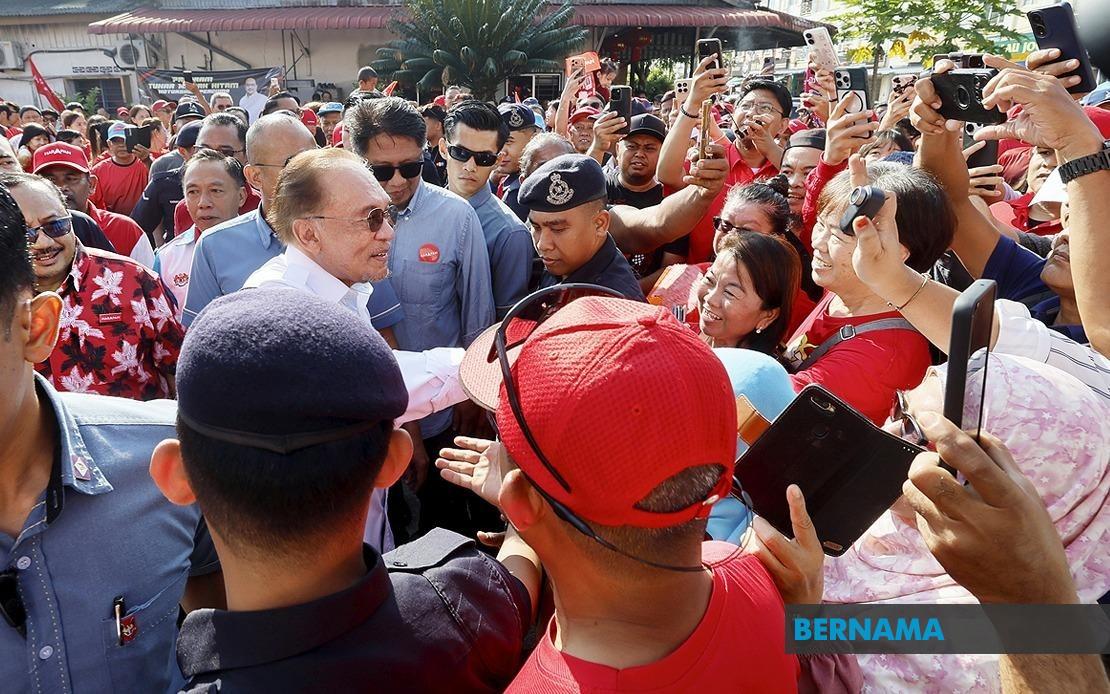
Prime Minister Datuk Seri Anwar Ibrahim has moved to address longstanding concerns about federal resource distribution by emphasising that his government maintains an impartial approach to all states, regardless of whether they are governed by opposition or ruling coalition parties. Speaking in Batu Pahat during a campaign event for the 16th Johor state election, Anwar rejected the notion that the federal administration discriminates against states based on political affiliation, framing this position as a fundamental principle of his leadership.
The Prime Minister, who simultaneously serves as chairman of the Pakatan Harapan coalition, grounded his argument in concrete examples rather than abstract policy declarations. He pointed to substantive investments flowing into Johor—a state where PH faces electoral competition—as evidence of the government's commitment to equitable resource allocation. By highlighting specific development corridors and infrastructure allocations, Anwar attempted to demonstrate that federal funding decisions respond to genuine need rather than partisan calculation.
Central to the Prime Minister's remarks was the Johor-Singapore Special Economic Zone development, a strategic project with significant economic implications for the southern region. This initiative transcends state-level politics by positioning Johor as integral to Malaysia's broader economic integration with Singapore and the wider Southeast Asian region. The project signals how federal infrastructure decisions can align with national economic objectives while simultaneously benefiting states regardless of their political composition.
Anwar also underscored the government's financial commitment to flood mitigation in Segamat and Muar, allocating billions of ringgit to address recurring natural disasters in these Johor districts. Flood management represents a critical welfare issue that directly affects residents' lives and livelihoods, making it difficult for critics to characterise such investment as politically motivated. By connecting infrastructure spending to tangible improvements in public safety and disaster resilience, the PM linked federal generosity to measurable community outcomes.
The broader context surrounding these remarks reflects ongoing political tension in Malaysia regarding federal-state resource distribution. Opposition-governed states have historically complained about receiving disproportionately lower federal allocations compared to coalition-ruled counterparts. These grievances have persisted across multiple administrations and remain a contentious issue in state-level electoral campaigns. Anwar's explicit denial of partisan discrimination thus addresses a persistent criticism that could influence voter perceptions during state elections.
Johor's political significance amplifies the importance of Anwar's reassurances. As Malaysia's second-most populous state and a longstanding stronghold with complex electoral dynamics, Johor has witnessed shifting political alignments in recent years. The state's economic importance—particularly its manufacturing base, port infrastructure, and proximity to Singapore—makes it strategically vital to any federal administration's development agenda. By demonstrating federal commitment to Johor through visible projects, the government seeks to build confidence among voters that political calculation does not override economic logic.
The campaign event itself, styled as 'Yok! Meriahkan Johor! Undi Harapan,' gathered prominent federal figures including Communications Minister and PH communications director Datuk Fahmi Fadzil alongside coalition candidates contesting the Senggarang, Semerah and Penggaram state seats. This assembly of federal and state-level party figures reinforced the coalition's message of unified governance and shared commitment to Johor's development, blending campaign messaging with assertions of administrative competence.
Anwar's statements also carry implications for federal-state relations more broadly. His implicit critique of election-time politics—referencing how previous governments made promises during campaign seasons without following through—positions his administration as governed by principles rather than electoral expediency. This framing suggests a distinction between short-term campaign messaging and long-term governance commitments, though such claims require sustained validation through consistent resource allocation decisions.
For Malaysian and Southeast Asian observers, these assertions about impartial governance matter considerably. Federal systems depend on maintaining legitimacy across geographically dispersed populations with varying political preferences. When voters perceive that federal resources flow primarily to allied states, faith in the fairness of democratic institutions erodes. Anwar's explicit denial of discriminatory practices serves important symbolic functions, even as the actual distribution of federal resources across states remains subject to verification and independent scrutiny.
The implications extend to Malaysia's economic competitiveness regionally. If federal infrastructure and development funds are allocated based on political rather than economic criteria, this could undermine long-term productivity and growth. The Johor-Singapore Special Economic Zone and similar initiatives require sustained, rational investment logic to achieve their economic potential. By anchoring his defence in concrete projects and bilateral economic benefits, Anwar frames federal support for Johor as economically rational rather than politically driven.
Moving forward, the credibility of the federal government's claims about impartial treatment will depend on actual resource flows over coming years. While current statements provide political reassurance to voters in competitive states, the real test lies in sustained implementation of promised projects and transparent accounting of federal expenditure across state boundaries. For a government seeking to rebuild trust in democratic institutions, demonstrating that development decisions reflect genuine need rather than partisan consideration remains essential to long-term political legitimacy.

