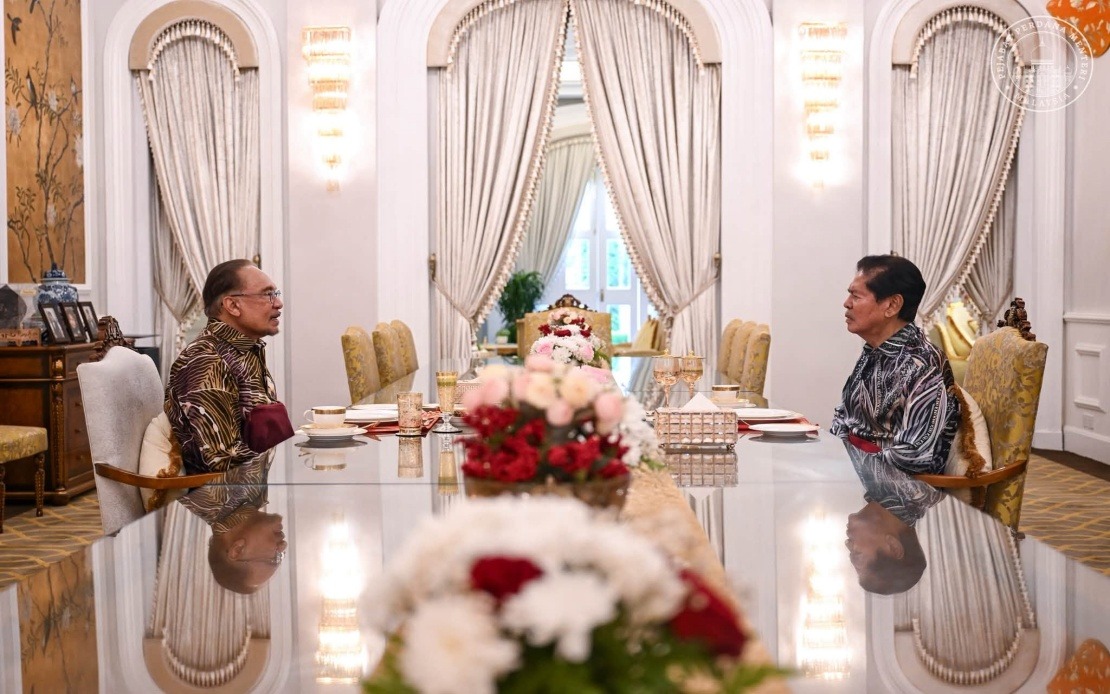
Prime Minister Datuk Seri Anwar Ibrahim brought his two-day working visit to Penang to a close on Thursday with an intimate tea reception at the official residence of the state's Governor, Tun Ramli Ngah Talib. The gathering at Seri Mutiara marked the final engagement of a busy itinerary that saw the Premier undertake several high-profile programmes across the northern state, reinforcing the Federal government's commitment to supporting regional development priorities and strengthening ties with the state administration.
In a Facebook statement following the meeting, Anwar highlighted how the reception had reinforced the collaborative relationship between Kuala Lumpur and Penang. He emphasised that both levels of government remained aligned in their strategic objectives, particularly regarding economic advancement and the improvement of living standards for residents. The tea reception thus served as a symbolic capstone to discussions held throughout the visit, demonstrating continuity of dialogue between state and Federal authorities on matters of mutual concern.
Tun Ramli, welcoming the Prime Minister, expressed genuine appreciation for Anwar's willingness to visit his residence before returning to the capital. The Governor characterised the meeting as a valuable opportunity to discuss a range of contemporary issues affecting both Penang and Malaysia at large. His remarks underscored the importance of regular engagement between state leadership and the Premier, a practice that helps ensure alignment on policy direction and resource allocation.
A notably personal touch emerged when Tun Ramli's grandson, Aldrey Alfi, participated in the reception. The young family member seized the opportunity to pose questions to the Prime Minister, who received the child warmly and patiently. Tun Ramli subsequently expressed his gratitude for this gesture, viewing it as emblematic of Anwar's approachable leadership style and his willingness to connect with Malaysians from all walks of life, regardless of age or formality.
Anwar's sojourn in Penang had been notably substantive, packed with engagements spanning different sectors and constituencies. The Prime Minister attended the launch of the Permatang Pauh Entrepreneur Revival Programme, an initiative aimed at supporting small and medium enterprises within the parliamentary constituency. This focus on economic empowerment at the grassroots level reflects the government's broader emphasis on inclusive growth and the democratisation of business opportunities beyond urban centres.
A further centrepiece of the visit was the Prime Minister's participation in the 15th Malaysia Scout Jamboree, one of the nation's premier youth engagement platforms. By attending this event, Anwar underscored the government's investment in youth development and character-building through scouting, an organisation that has long served as a incubator for civic values and outdoor skills among young Malaysians. His presence at such gatherings also signals executive-level recognition of the scouting movement's role in nation-building.
The MADANI Sahabat 2026 National Day Countdown Programme represented another significant strand of Anwar's Penang itinerary. This initiative aligns with the government's broader messaging around the MADANI framework, which prioritises prosperity, inclusivity, and unity. The programme's focus on 2026, roughly three years ahead, suggests strategic planning around national celebrations and the embedding of MADANI principles into public discourse during the period leading toward Malaysia's independence milestone.
The diversity of Anwar's engagements across Penang reflects a political strategy that balances high-level state relations with direct engagement across multiple constituencies and demographics. By addressing entrepreneurs, youth, and the broader public through commemorative events, the Prime Minister demonstrates an attempt to build broad political support while addressing substantive policy objectives. For Penang particularly, these visits provide opportunities to secure Federal resources and policy flexibility for state-level development initiatives.
The tea reception at Seri Mutiara thus functioned as more than a ceremonial conclusion; it represented a moment of official consolidation. Such meetings between the Prime Minister and state governors carry diplomatic weight, establishing or reinforcing frameworks for cooperation on matters ranging from infrastructure to social services. For Penang, historically a state with its own distinct political character and sometimes fractious relationships with Federal authority, such harmonious exchanges carry significance in demonstrating that collaborative federalism remains operational.
Looking forward, the pattern of Anwar's engagement with Penang suggests an intention to maintain regular high-level contact and to position the Federal government as an active partner in the state's development trajectory. This approach contrasts with periods in which centre-state relations have been more distant or adversarial. By investing time in multiple programmes and culminating with a personal meeting with the Governor, Anwar is signalling that Federal-state cooperation is a priority, which may bear fruit in terms of enhanced funding flows, policy coordination, or political goodwill in future legislative or administrative matters.

