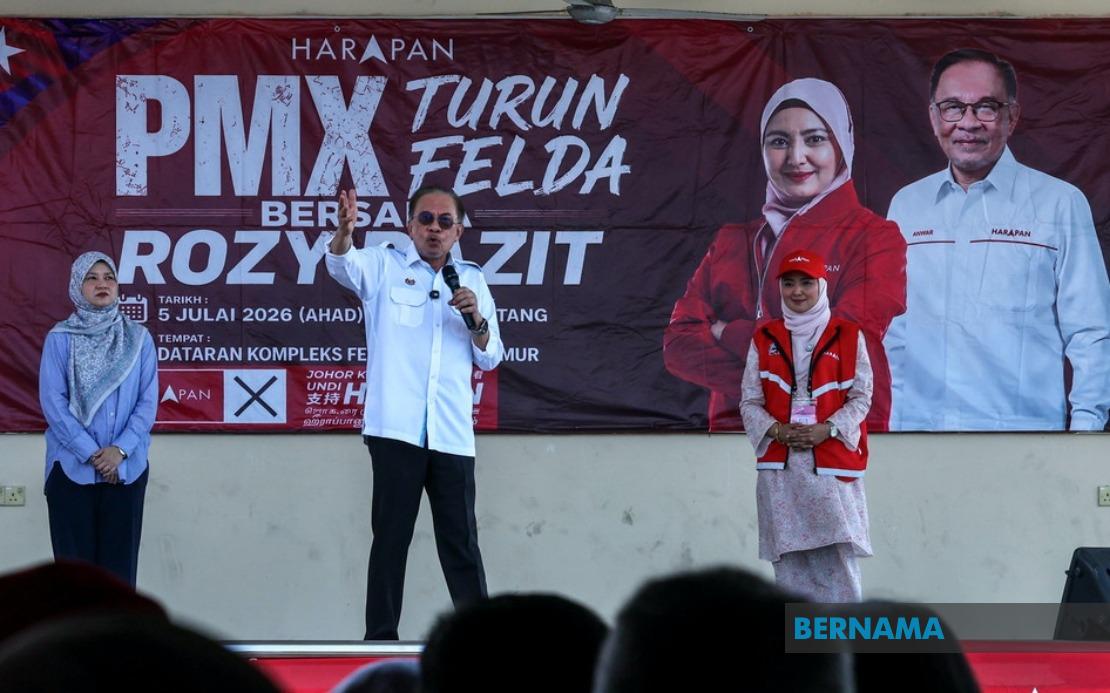
Prime Minister Datuk Seri Anwar Ibrahim has made an explicit commitment to resolve a housing crisis affecting the second generation of FELDA settlers, marking a renewed focus on an issue that has plagued Malaysia's agricultural communities for decades. Speaking during a public engagement in Segamat, the prime minister underscored his administration's determination to provide housing sites and guarantees for this vulnerable population, framing the matter as both a policy priority and a personal mission during his tenure.
The FELDA second-generation housing problem represents one of Malaysia's most enduring rural welfare challenges. When FELDA settlers were granted land and housing decades ago, the scheme's benefits were not automatically extended to their children, leaving thousands of young adults without formal access to property or development opportunities. This structural gap has created intergenerational disadvantage within these communities, where younger residents often lack the assets and stability their parents enjoyed through the original FELDA framework, perpetuating cycles of limited economic mobility.
Anwar's pledge carries significant political weight, as FELDA settlements represent important electoral constituencies and contain voters with long institutional memory of government promises. The prime minister's emphasis on settling matters "while I am Prime Minister" suggests awareness that previous administrations have failed to deliver on similar commitments, and that tangible progress is essential for maintaining public confidence. By anchoring the commitment personally, he positioned himself as accountable for outcomes rather than allowing the issue to fade into bureaucratic limbo.
However, the prime minister acknowledged a critical structural constraint: resolving this crisis requires active cooperation from state governments, since land administration and infrastructure provision fall within state jurisdiction rather than federal control. This devolution of responsibility to state authorities introduces both opportunity and risk. In states with aligned political leadership, coordinated federal-state action could accelerate implementation; conversely, in states with opposing political control, territorial disagreements or competing priorities could slow progress. Selangor Menteri Besar Datuk Seri Amirudin Shari's presence at the event suggests PKR-aligned states may be more receptive, but Anwar must navigate cooperation across multiple jurisdictions with varying political complexities.
The infrastructure dimension proves particularly challenging. Providing housing sites requires not merely land allocation but also basic utilities—water supply, electricity, sewerage systems, and road access. These elements demand sustained capital investment and technical coordination between federal agencies, state governments, and local authorities. The cost implications are substantial, particularly if the government commits to subsidised or concessional housing schemes to make properties affordable for settler families whose economic circumstances remain modest.
Anwar's framing positions the second generation as deserving protection and guarantees, language that implies more than provisional or temporary arrangements. This suggests potential legislative or regulatory reform to formalise second-generation rights within the FELDA framework, possibly amending the original FELDA Act or establishing new eligibility mechanisms. Such institutional changes would require parliamentary action and careful drafting to avoid unintended consequences or legal challenges.
The attendance of Education Minister Fadhlina Sidek and Deputy National Unity Minister R. Yuneswaran alongside the Segamat MP indicates cross-portfolio government focus on rural welfare and social cohesion. This multi-ministerial engagement reflects understanding that FELDA communities touch multiple policy areas—agricultural policy, rural development, social welfare, and national unity. The presence of state-level leadership further underscores the integrated approach necessary.
For Malaysian and Southeast Asian observers, this commitment carries implications beyond FELDA itself. Rural land settlement schemes exist throughout the region, and similar second-generation housing gaps affect communities in Indonesia, Thailand, and the Philippines. Malaysia's approach to resolving the FELDA crisis could establish precedent or offer lessons for neighbouring countries wrestling with comparable agricultural settlement legacies. Success would demonstrate effective federal-state coordination on welfare provision; failure would reinforce perceptions that resource constraints and governance fragmentation prevent lasting solutions to intergenerational poverty.
The timing of Anwar's public commitment during a meet-the-people programme reflects strategic political communication. Rather than announcing policy through formal channels, the prime minister chose direct engagement with affected communities, signalling accessibility and genuine responsiveness. This approach builds political capital within FELDA constituencies while creating public accountability—communities can now hold the government to the explicitly stated objective.
Implementation success will depend on several variables beyond Anwar's direct control. State revenue positions and infrastructure capacity vary significantly across Malaysia's thirteen states. Federal budget allocation to FELDA housing initiatives must compete with other priorities such as healthcare, education, and economic stimulus. Economic conditions affecting construction costs and land values will influence programme feasibility and affordability parameters.
The second-generation housing issue also intersects with broader questions about FELDA's institutional future. As original settlers age and retire, questions arise about succession planning, environmental sustainability of palm oil production, and whether land-settlement models remain appropriate development tools. Housing provision for the second generation cannot be divorced from these larger strategic questions about FELDA's role in contemporary Malaysia.
Anwar's commitment represents recognition that decades of policy neglect have created legitimate grievances within agricultural communities. By making explicit promises tied to his personal leadership, the prime minister has elevated the issue's political salience and accepted direct accountability for progress. The coming months will reveal whether federal-state cooperation can translate commitment into concrete housing provision for thousands of families awaiting long-overdue development opportunities.

