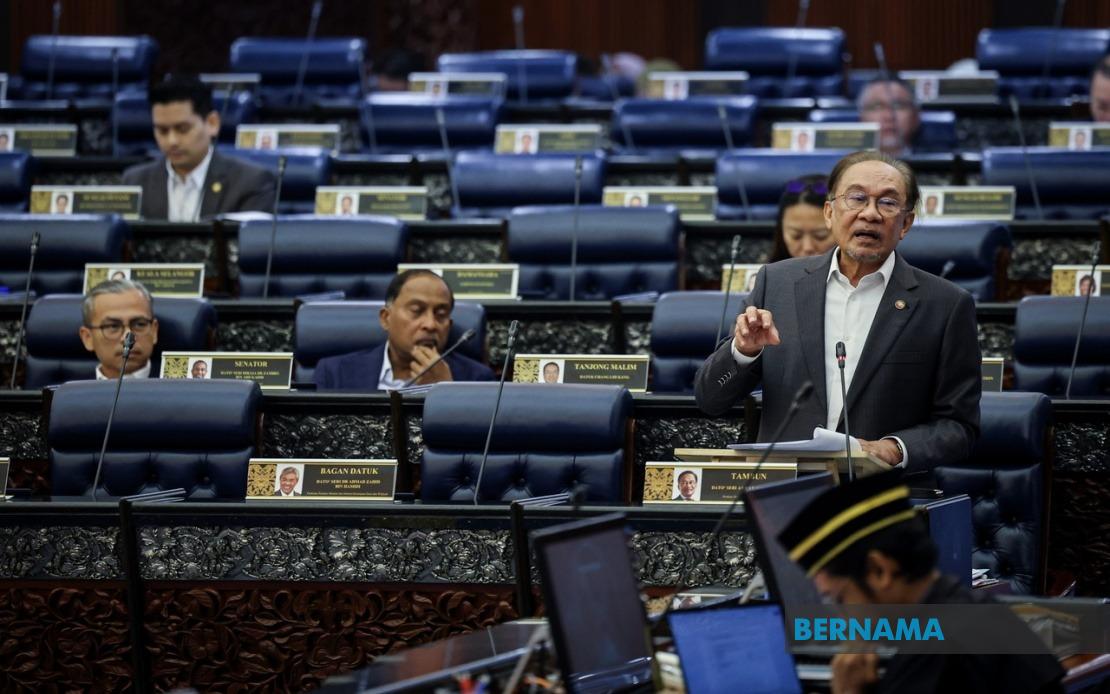
Prime Minister Datuk Seri Anwar Ibrahim moved to defuse controversy surrounding his public comments on the Johor state election polling date, emphasising during parliamentary proceedings that his observations reflected personal preference rather than any directive towards the Election Commission. Speaking in the Dewan Rakyat during Minister's Question Time, Anwar distinguished between his suggestion that Sunday voting might be preferable and the constitutional independence of the EC in determining actual polling dates.
The clarification came after Ahmad Fadhli Shaari, the Pasir Mas member representing Perikatan Nasional, sought parliamentary confirmation that Anwar's campaign-trail statements about Saturday versus Sunday elections did not constitute overreach into the EC's mandate. The question reflected broader sensitivities in Malaysian politics about the boundary between political leadership and electoral administration, an institution jealously guarded as autonomous under the Federal Constitution.
Anwar's rationale for preferring Sunday voting drew on demographic realities particular to Malaysia's relationship with Singapore. Thousands of Malaysian workers commute to Singapore daily or maintain employment there, often working Saturday mornings. A Sunday election would theoretically provide these voters a clearer window to return across the causeway and fulfil their franchise obligations without sacrificing income. This practical consideration, Anwar suggested, motivated his public positioning rather than any desire to prescribe the EC's methodology.
The distinction Anwar articulated mirrors international discussions about prime ministerial latitude in democratic systems. While leaders may express policy preferences on matters of national interest, electoral administration represents a protected sphere where executive opinion should not translate into institutional pressure. By framing his comments as contextual observation rather than directive, Anwar sought to protect the EC's credibility as a non-partisan arbiter at a politically sensitive moment.
The Johor state election campaign had evidently become a vehicle for broader discussion of voting logistics and accessibility, with Anwar's remarks gaining media traction precisely because prime ministerial commentary on election mechanics carries amplified weight in Malaysia's political economy. His parliamentary intervention functioned as a reset, repositioning his earlier observations within acceptable bounds of democratic discourse rather than as attempted manipulation.
A second line of questioning, posed by Mohd Sany Hamzan from the Hulu Langat constituency, suggested that Malaysia formally approach Singapore's government to arrange facilitation for cross-border voters. This proposition touched upon even more sensitive constitutional terrain, as it implied diplomatic intervention in what Anwar correctly identified as Malaysia's purely domestic electoral process. The Prime Minister firmly declined to pursue such engagement, citing both Malaysia's principled commitment to electoral non-interference and the propriety of treating voting mechanics as sovereign matters.
Anwar's response clarified that while he maintains warm personal and official relations with Singapore Prime Minister Lawrence Wong, those bilateral ties do not extend into the operational details of Malaysian elections. The distinction proved important: cordial international relations do not justify external involvement in internal democratic procedures, a principle Malaysia itself insists upon when monitoring bodies assess its electoral conduct.
However, Anwar did acknowledge that Malaysian companies operating in Singapore had been advised of upcoming electoral opportunities, enabling employers to grant staff appropriate leave to return and vote. This represents a pragmatic, non-governmental accommodation between the private sector and worker citizenship obligations, fundamentally different from inter-governmental negotiation over election administration. The distinction allows Malaysia to address practical obstacles facing cross-border workers without compromising electoral sovereignty.
The entire exchange illuminated the complex machinery required to sustain democratic participation in a region defined by high labour mobility. Malaysia hosts significant expatriate populations, while simultaneously exporting large numbers of its own citizens to Singapore and beyond. Elections occurring on weekdays or at times inconvenient for workers abroad necessarily reduce turnout among this mobile demographic, potentially skewing electoral outcomes towards geographically stable populations. Yet solving this through international coordination rather than domestic logistical innovation raises uncomfortable questions about electoral representation and fairness that remain largely unresolved across Southeast Asia.
Anwar's parliamentary clarifications effectively closed off political leverage on the EC's scheduling decision while preserving his government's capacity to encourage inclusive voting practices through domestic corporate channels. The measured tone and explicit endorsement of EC independence suggested recognition that public disputes over electoral administration damage democratic institutions more broadly, particularly in a region where questions about electoral integrity periodically surface. By reframing his position as supportive suggestion rather than policy demand, Anwar attempted to model appropriate deference to constitutional bodies.
The Johor election thus became a laboratory for examining how Malaysian political leaders navigate between legitimate advocacy for voter accessibility and necessary restraint regarding institutional autonomy. Anwar's performance suggested an understanding that modern democratic leadership requires defending not just particular electoral outcomes but the credible independence of the institutions conducting elections themselves.

