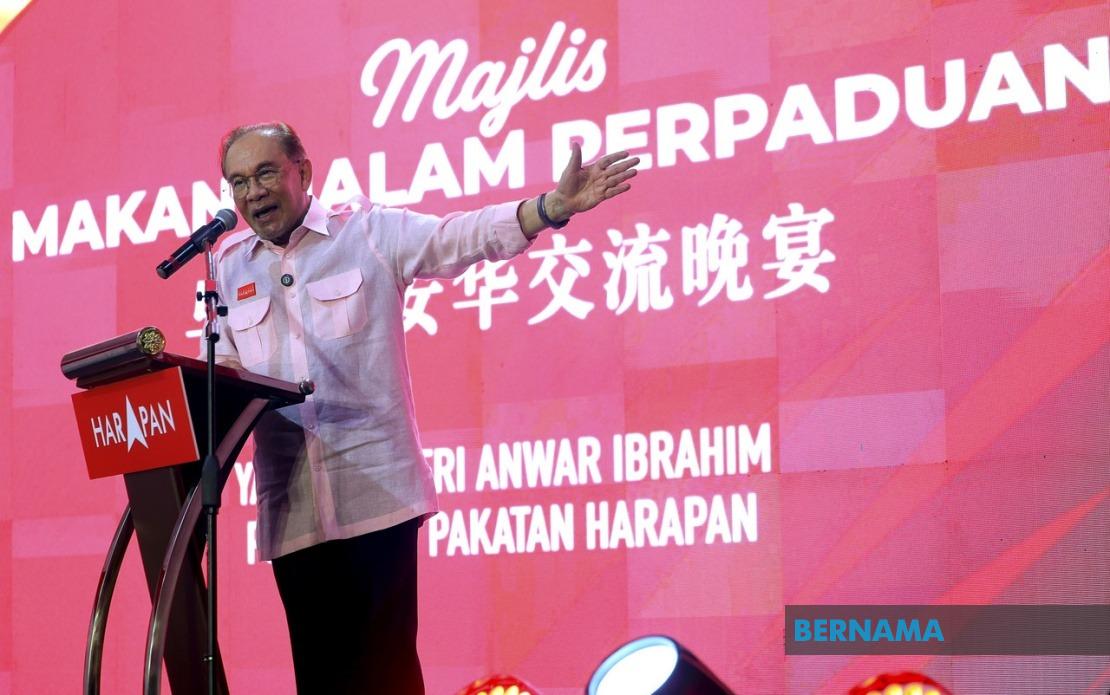
Datuk Seri Anwar Ibrahim seized the campaign trail in Negeri Sembilan on Tuesday evening to draw a sharp contrast between Pakatan Harapan's governing approach and what he characterized as unseemly internal power struggles within the opposition. Speaking at a coalition dinner in Sikamat, the PKR president and PH chairman highlighted the spectacle of multiple rival candidates already jockeying for the menteri besar role, a dynamic he suggested would only intensify should they win control of the state assembly. His intervention underscores the coalition's broader election strategy: positioning itself as the faction focused on competent administration rather than personal ambition or factional rivalry.
The timing of Anwar's remarks carries particular significance for Negeri Sembilan's political landscape. The August 1 state election represents a crucial test for the Unity Government's ability to retain control of a state it currently administers. By flagging opposition discord now, during the campaign's final stretch, PH aims to reinforce messaging that governance rather than power consolidation should drive voter decisions. The implicit argument is that while opposition parties spend energy resolving their internal power dynamics, the coalition can focus on delivering services and managing state affairs with continuity and stability.
Anwar's criticism of opposition infighting reflects a tactical calculation rooted in Malaysian electoral politics. State elections typically hinge on bread-and-butter issues and incumbent performance, yet leadership questions have historically mobilized voters during contests. By forcing the opposition narrative toward internal conflict, PH potentially shifts focus away from areas where opponents might gain traction, such as cost-of-living concerns or perceived governance shortcomings. The strategy assumes that voters, particularly swing constituencies, will reward perceived unity and stability over promises of dramatic change coupled with visible internal tension.
The prime minister also deployed his considerable political capital to endorse incumbent Menteri Besar Datuk Seri Aminuddin Harun, whom PH is running in the Linggi constituency. Anwar praised Aminuddin's administrative record, specifically highlighting the absence of corruption and abuse of power allegations during his tenure. This emphasis on clean governance reflects PH's post-2018 election rebranding, when the coalition campaigned heavily on anti-corruption messaging following the 1MDB scandal. Maintaining that narrative remains central to the coalition's legitimacy, particularly among urban and middle-class constituencies.
Anwar also took direct aim at what he described as racial narratives being weaponized during the campaign by unspecified quarters. His comment alluded to a perennial feature of Malaysian electoral politics: the deployment of communal appeals to mobilize specific voter blocs. By calling this tactic out explicitly, the PKR president attempted to position the Unity Government as above such divisive politics, a positioning that appeals particularly to multiethnic urban areas and educated voters concerned about polarization. The remark also serves as a preemptive response should opposition parties attempt to mobilize Malay-Muslim voters through appeals centered on religion or ethnicity.
In response to these charges of divisive campaigning, Anwar articulated the Unity Government's governing philosophy as one rooted in inclusive policy implementation. He highlighted recent achievements including expanded socio-economic allocations, new housing initiatives, and salary adjustments for civil servants. These concrete examples ground the abstract concept of inclusive governance in tangible benefits, making the coalition's pitch less ideological and more material. For Malaysian voters evaluating coalition performance, such specificity matters considerably more than rhetorical commitment to multiethnic principles.
Packatan Harapan is contesting all 36 seats in the Negeri Sembilan state assembly, with the constituent parties dividing candidacies according to existing strength. PKR is fielding 16 candidates, DAP 11, and Amanah nine, a distribution reflecting the coalition's internal hierarchy and regional presence. This unified slate represents a departure from the competitive dynamics evident in some previous elections, where coalition partners occasionally fielded rival candidates in the same constituency. Full cooperation signals both confidence in PH's electoral prospects and a disciplined approach to maximizing coalition competitiveness.
The Negeri Sembilan contest occurs within a broader context of Malaysian electoral volatility. The state has swung between governing coalitions multiple times in recent decades, most notably when Barisan Nasional lost control in the 2018 general election. The subsequent 2021 state election saw PH retain Negeri Sembilan with a reduced majority, signaling that incumbent advantage does not guarantee smooth victory. Current polling and ground assessments suggest a competitive race, making Anwar's personal engagement and high-profile campaigning strategically essential. His presence lends national-level gravitas to state-level contests, potentially energizing the coalition base and demonstrating party leadership commitment to retaining this critical state.
Socioeconomic concerns dominate voter preoccupations in Negeri Sembilan as elsewhere in Malaysia. Rising inflation, housing affordability, and employment opportunities affect daily calculations in constituencies ranging from industrial areas to agricultural regions. While Anwar's campaign messaging touched on these domains through policy examples, the depth of voter engagement with such material depends substantially on ground-level campaign infrastructure and incumbent performance visibility. The August 1 election will partly reflect whether PH's national-level messaging on socioeconomic management translates into sufficient local-level traction.
Early voting on July 28 precedes the main polling day, a scheduling that typically benefits incumbent parties with superior voter mobilization machinery. PH's organizational capacity, built through multiple national and state-level contests since 2018, should provide advantages in getting supporters to cast ballots early. However, this procedural advantage alone cannot guarantee electoral success absent sufficient underlying support. The Opposition's performance in Negeri Sembilan will reveal whether internal discord that Anwar highlighted translates into electoral consequences or represents merely a distraction from substantive campaign messages.
The Opposition's response to Anwar's criticism of menteri besar jostling will likely emphasize their rival qualifications and leadership vision rather than directly defending internal competition. Such defensive moves risk validating Anwar's central charge, whereas offensive repositioning might highlight governance failures or broken promises by the incumbent PH administration. This rhetorical terrain will shape the final week of campaigning, with voter perception of which coalition possesses greater unity and capability potentially swinging marginal constituencies.
Looking beyond August 1, the Negeri Sembilan election serves as a significant barometer for national politics. A decisive PH victory would reinforce the Unity Government's electoral credibility ahead of the next general election, while an opposition breakthrough would embolden rivals questioning the coalition's longevity. For Malaysian observers monitoring regional political dynamics, Negeri Sembilan's outcome carries implications extending well beyond its 36 assembly seats, potentially influencing coalition calculations and opposition confidence throughout Southeast Asia's most politically consequential democracy.

