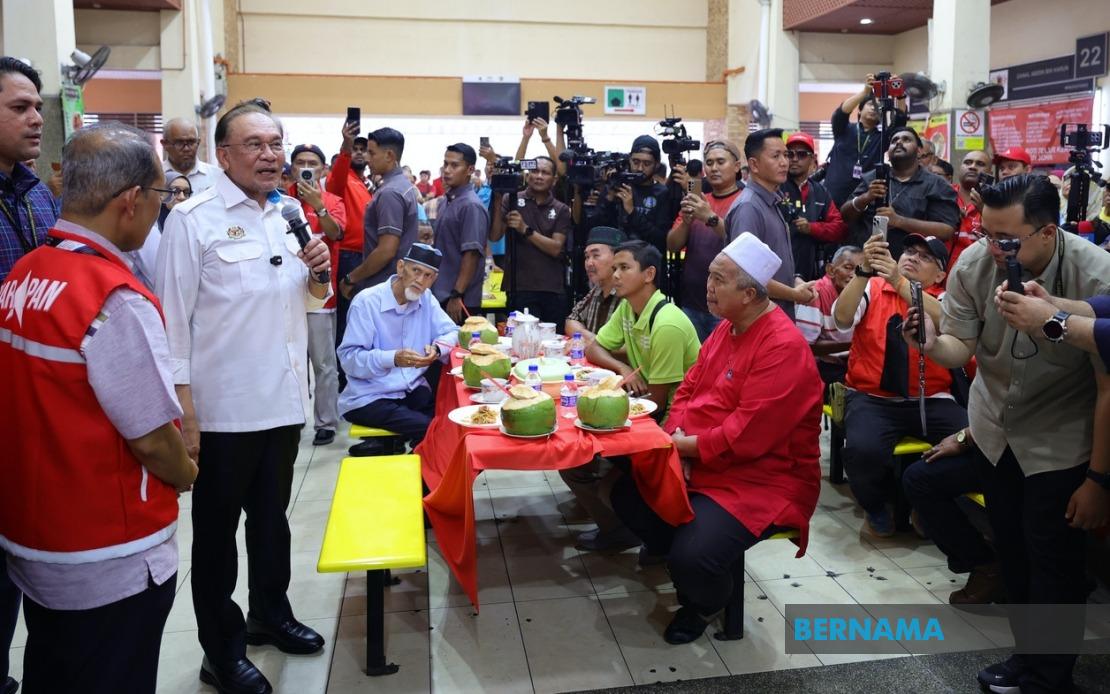
Prime Minister Datuk Seri Anwar Ibrahim made an impassioned appeal to voters in Negeri Sembilan on Monday, calling for continued support of Pakatan Harapan in the state's upcoming election. Speaking during a campaign visit to Seremban, Anwar framed the ballot as a choice between maintaining the political cohesion that has underpinned recent progress or risking institutional fragmentation that could impede development efforts. His intervention underscores the federal government's strategic interest in securing a dominant position at state level, where aligned leadership can synchronise policy implementation and resource allocation more efficiently.
The Prime Minister, who also chairs Pakatan Harapan, stressed that a strengthened mandate would allow the state administration to operate in concert with federal authorities, creating the institutional alignment necessary to execute development initiatives and social welfare programmes without administrative friction or competing political agendas. This framing reflects a broader political reality in Malaysia's federal system: state governments aligned with the federal ruling coalition typically experience smoother bureaucratic processes, more favourable budget allocations, and fewer legislative obstacles. Conversely, opposition-controlled states have historically faced constraints in infrastructure funding and federal cooperation. Anwar's argument essentially positions the election as a referendum on efficient governance rather than ideological choice.
Anwar acknowledged the tenure of Menteri Besar Datuk Seri Aminuddin Harun, crediting the state administration's stability over the preceding three years to collaborative governance among all political factions. This observation carries particular weight given Malaysia's fractious recent political history, during which several state governments experienced defections, party-hopping, and institutional paralysis. Negeri Sembilan's relative calm contrasts sharply with other states that witnessed dramatic political upheaval, making stability itself a tangible campaign asset rather than an abstract promise. The Prime Minister's emphasis on this track record suggests PH strategists believe voters will reward continuity over experimentation.
While presenting the government's record as commendable, Anwar adopted a notably pragmatic tone by acknowledging imperfection. He explicitly conceded that not all policies have succeeded entirely, inviting voters to view the election less as an endorsement of flawless governance and more as a continuation of an ongoing improvement process. This rhetorical approach may resonate with voters fatigued by political perfectionism and disappointed by unfulfilled campaign promises from multiple cycles. By admitting shortcomings yet requesting another chance, Anwar positioned the coalition as willing to learn and adapt, potentially neutralising criticism that could otherwise erode support.
The Prime Minister's call for feedback and commitment to implementation of voter suggestions represents a calculated effort to reconstruct public trust in institutional responsiveness. After the turbulent political cycles of 2018 to 2023, during which Malaysia experienced three changes of federal government and significant public disillusionment, such appeals to participatory governance carry particular resonance. For Negeri Sembilan specifically, a state with traditional Malay-Muslim demographics and significant Chinese minority populations, the promise of responsive administration tailored to community input addresses longstanding grievances across multiple constituencies.
Pakatan Harapan's candidate distribution reveals the coalition's internal power dynamics and demographic targeting strategy. The allocation of 16 seats to PKR, eleven to DAP, and nine to Amanah reflects the traditional bargaining arrangement among the three partners, with PKR's dominance reflecting its role as the largest component and its possession of significant grassroots machinery in Negeri Sembilan. The coalition's decision to contest all 36 seats demonstrates confidence in retaining control, signalling that it foresees no substantial threat from fragmentation within its ranks or abandonment by component parties seeking independent advantage.
The Election Commission's scheduling of the contest for August 1, with early voting on July 28, follows standard procedures established for recent Malaysian elections. The timing aligns with Malaysia's broader electoral cycle and represents the second state election conducted since Pakatan Harapan's return to federal office in November 2022. Negeri Sembilan thus becomes a bellwether for assessing the coalition's capacity to consolidate power at subnational level and whether the reform agenda articulated in 2022 continues to resonate with voters.
For the broader Southeast Asian political context, the Negeri Sembilan election reflects patterns observable across the region: voters increasingly prioritise institutional stability and demonstrable service delivery over ideological positioning or factional loyalty. This shift represents a maturation of electoral behaviour in which economic performance and administrative competence increasingly outweigh tribal or party identifications. Malaysia's experience in this regard may offer instructive parallels for other democracies in the region wrestling with similar voter expectations and the challenge of delivering results in contexts of constrained resources and competing demands.
The campaign represents the first significant test of Pakatan Harapan's political appeal since the federal government's formation, occurring amid economic pressures including inflation and unemployment concerns that have affected household purchasing power across Malaysia. Should the coalition maintain or expand its Negeri Sembilan foothold, it would signal voter validation of its governance approach and provide momentum heading into the subsequent federal electoral cycle. Conversely, a diminished mandate could expose fractures within the coalition or suggest voter reluctance to grant extended authority without demonstrating more substantial improvement in living standards and economic conditions.
Anwar's personal involvement in the campaign, despite his federal responsibilities, reflects the strategic importance attributed to this contest within the political establishment. The Prime Minister's presence amplifies the campaign's scale and suggests Pakatan Harapan views potential loss or substantial erosion of support as an unacceptable political outcome. Such intensive leadership engagement often indicates internal coalition anxiety about baseline support levels or concerns that complacency might undermine turnout and performance. The visible investment of prime ministerial capital in a single state election underscores the contest's significance as both a measure of current political health and a potential harbinger of broader electoral trends as Malaysia approaches the next federal balloting cycle.

