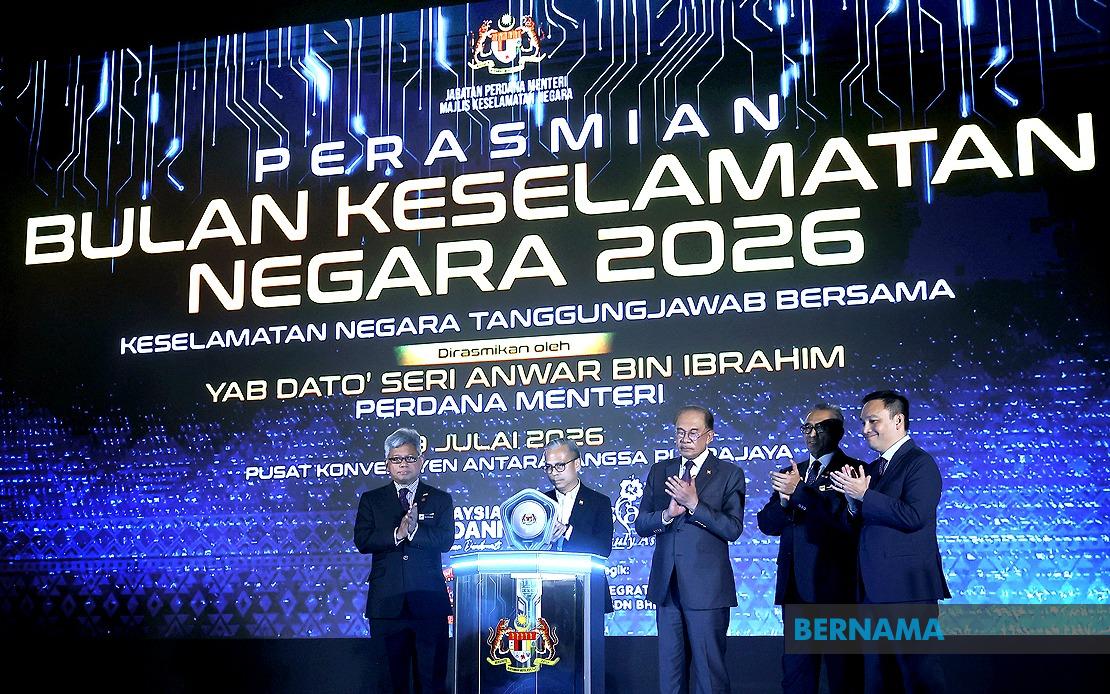
Prime Minister Datuk Seri Anwar Ibrahim has issued a stark warning about the dangers of perpetuating divisive political narratives rooted in identity, race and regional sentiment, arguing that these tired rhetorical battles are preventing Malaysia from adequately addressing far more pressing security challenges in an increasingly complex threat landscape. Speaking at the National Security Month 2026 programme organised by the National Security Council in Putrajaya on July 9, Anwar expressed frustration with what he characterised as a persistent tendency among political actors and commentators to rehash old grievances rather than confront the evolving security environment facing the nation.
The Prime Minister's remarks underscore a fundamental strategic concern: that domestic political divisions, whether rooted in ethnic identity, religious affiliation or state interests, are consuming disproportionate attention and resources at a moment when Malaysia confronts threats of unprecedented sophistication and scope. Anwar noted that contemporary security challenges extend far beyond traditional borders and conventional definitions of threat, encompassing technological vulnerabilities, digital exploitation, and cyber-based attacks that do not respect the sectarian or geographical dividing lines that have historically animated Malaysian political discourse. His intervention signals frustration with what appears to be the persistence of identity-based politics even as global security dynamics shift fundamentally.
The Malaysian Prime Minister, who also holds the Finance Ministry portfolio, observed that parliamentary debates and political discourse continue to revolve around historical fault lines—questions of race, religion, federalism and regional autonomy—rather than engaging seriously with the transnational, technological and institutional challenges that demand immediate government attention. This pattern, he suggested, represents a critical misallocation of political energy and intellectual resources at precisely the moment when the nation requires a unified, forward-looking strategic posture. The observation carries weight given the cross-party presence at the security forum, suggesting that Anwar is directing his critique across the entire political spectrum rather than targeting opposition parties exclusively.
Anwar's call for strategic reorientation reflects a broader Southeast Asian predicament. Throughout the region, governments confront similar pressures: rising geopolitical competition, transnational organised crime networks, climate-related migration and instability, cyber warfare capabilities, and emerging technologies like artificial intelligence that complicate intelligence and defence operations. Yet in many instances, including Malaysia, domestic political competition continues to centre on identity-based mobilisation rather than substantive policy engagement with these transnational realities. The Prime Minister's intervention suggests frustration with this structural mismatch between the actual threat landscape and the political agenda.
The security challenges Anwar referenced are not abstract concerns. Malaysia has experienced considerable cyber-crime activity, including ransomware attacks targeting critical infrastructure and government agencies. Digital threats affect financial systems, defence networks, and civilian infrastructure simultaneously. Additionally, Malaysia's maritime domain remains contested in various ways, from piracy concerns to territorial disputes. Extremist recruitment has historically exploited both online platforms and communal divisions, while transnational crime syndicates continue to operate through the region with relative impunity, trafficking in drugs, persons and arms. These challenges require coherent, well-resourced, technologically sophisticated responses that cannot be improvised or subordinated to electoral cycles.
Anwar emphasised that the responsibility for adopting a more anticipatory, proactive security posture extends across the entire governmental apparatus, from cabinet-level ministries through to frontline agencies. He characterised security as something far more consequential than routine administrative function, demanding that leaders in every department rapidly acquire understanding of emerging technologies and novel security phenomena. This framing suggests recognition that security threats are no longer the exclusive domain of defence and law enforcement agencies but rather present challenges that cut across health, education, finance, communications and infrastructure portfolios. The implicit message is that siloed thinking and incremental responses to crisis situations represent inadequate governance approaches.
The gathering included Communications Minister Datuk Fahmi Fadzil, Chief Secretary to the Government Tan Sri Shamsul Azri Abu Bakar, and National Security director-general Datuk Raja Nurshirwan Zainal Abidin, indicating high-level government engagement with security planning and articulating an apparent consensus around Anwar's strategic diagnosis. The presence of these officials at a public programme discussing security priorities suggests an effort to project governmental unity around threat assessment and response strategies. For Malaysian and Southeast Asian observers, the implicit message is that security considerations have risen sufficiently in governmental priority to warrant prime ministerial intervention in shaping political discourse itself.
Anwar's intervention also carries implications for how Malaysia engages with regional security architecture and international partnerships. Nations operating from positions of domestic division typically encounter difficulties articulating coherent foreign and defence policies. Conversely, societies able to subordinate partisan competition to collective security interests can pursue more sustained, consistent strategies in bilateral relationships, multilateral institutions, and regional security forums. Malaysia's role in ASEAN, its importance to global maritime trade and its strategic location between major powers all argue for the kind of unified approach Anwar is advocating.
The warning against dwelling on "old issues" should not be misinterpreted as hostility toward legitimate discussion of historical injustices, constitutional arrangements, or institutional design questions. Rather, Anwar's concern appears to be with the reduction of these substantive matters to periodic political theatre serving short-term electoral advantages, rather than deliberative engagement aimed at building workable institutional compromises. The distinction matters: serious engagement with constitutional questions, resource distribution, and representation differs fundamentally from cynical deployment of divisive rhetoric to mobilise voter blocs without intention of substantive reform.
Looking forward, Anwar's remarks suggest that the government intends to elevate security briefings and strategic planning to more prominent roles in public discourse and policy formation. The National Security Month programme itself, coupled with the Prime Minister's participation and thematic framing, indicates an effort to normalise security considerations in public consciousness beyond moments of acute crisis. For Malaysia and the region, this represents a potentially significant shift in how political leaders articulate national priorities and invite public understanding of governmental decision-making.
The fundamental challenge Anwar identifies is structural and difficult: how to maintain security while preserving the pluralistic character of a diverse society. This tension cannot be permanently resolved but rather requires continuous calibration and renewal of social compacts. Yet his insistence that contemporary security threats demand focused, proactive, technologically sophisticated responses represents a reasonable analytical position rooted in observable realities of the modern security environment. Whether Malaysian political discourse will actually shift as he advocates remains uncertain, but his public articulation of these concerns signals that leadership recognises the stakes involved.

