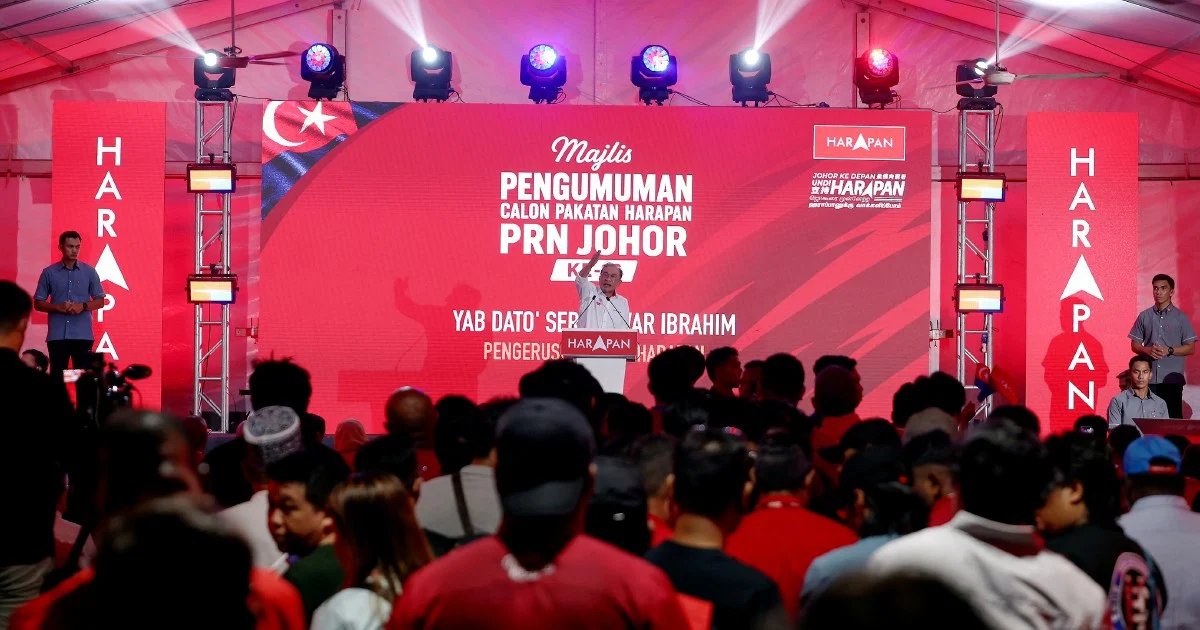
Prime Minister Datuk Seri Anwar Ibrahim has issued a clear directive that the upcoming Johor state election should be contested purely as a political matter, with no involvement from the Malay Rulers or their institutions. Speaking during a campaign visit to Tangkak, the Pakatan Harapan chairman underscored the importance of maintaining a clear separation between electoral contests and the constitutional role of the monarchy in Malaysia's political system.
Anwar's remarks reflect a broader concern within PH about the potential risks of entangling royal institutions in partisan electoral campaigns. The statement carries particular weight given Malaysia's constitutional framework, which prescribes specific and limited roles for the Malay Rulers. By publicly drawing this boundary, the Prime Minister appears to be setting expectations not only for PH's conduct during the campaign but also signalling to other political actors the parameters within which the election should be contested.
The emphasis on keeping the contest political rather than institutional speaks to deeper anxieties about the integrity of Malaysia's electoral process. When state elections become contested terrain where non-political actors are drawn in, it can undermine public confidence in the neutrality of institutions that are meant to stand above the fray. This is especially significant in Johor, a state with a strong historical connection to its royal household and where the Sultan commands considerable public respect and affection.
Anwar's intervention also reflects the delicate balance Malaysian political leaders must strike when navigating the intersection of electoral politics and constitutional monarchy. The Malay Rulers occupy a revered position in Malaysian society and governance, yet they are meant to be politically neutral. When their names or institutions become associated with particular electoral outcomes or campaigns, it risks compromising that neutrality and placing them in an awkward position.
The context of Johor is particularly sensitive. The state's royal institution has historically wielded considerable influence over political affairs. Ensuring that the upcoming election remains a contest between political parties, fought on policy grounds and electoral merit, serves to reinforce the principle that electoral legitimacy derives from the people's choice rather than from endorsements by traditional power structures.
By articulating this principle publicly, Anwar may also be seeking to preempt any attempts by rival coalitions to invoke royal support or invoke the monarchy's name in ways that could be seen as endorsements. The statement functions as both a principled declaration of how elections ought to be conducted and a practical signal about the kind of campaign environment PH expects to see.
The distinction Anwar draws between political competition and institutional involvement carries implications beyond this single state election. It reinforces a vision of Malaysian democracy where outcomes are determined through democratic processes involving voters, candidates, and political parties, rather than through behind-the-scenes negotiations or pressures involving traditional authorities. This approach strengthens the institutions of representative democracy even as it respects the constitutional role of the monarchy.
For Malaysian voters, particularly in Johor, such clarity about the proper boundaries of political contestation can serve a valuable function. It sets expectations about how campaigns should be conducted and signals commitment to democratic norms. When political leaders themselves establish and respect these boundaries, it contributes to a political culture where democratic rules and constitutional principles are genuinely observed rather than treated as obstacles to be circumvented.
The Pakatan Harapan chairman's emphasis also acknowledges the unique position of Johor within Malaysia's political landscape. As a state with a particularly prominent royal household, the temptation to invoke royal backing or to present political outcomes as having royal sanction might be greater there than elsewhere. By explicitly ruling this out, Anwar establishes a clearer standard for how the campaign should unfold.
Moreover, Anwar's statement reflects an understanding that maintaining public trust in both democratic institutions and the monarchy requires careful stewardship. The reputational health of the Malay Rulers depends partly on their ability to remain above partisan political divisions. Similarly, the credibility of electoral outcomes depends on public perception that they reflect genuine democratic choice rather than deals struck behind closed doors involving powerful traditional actors.
As the Johor state election approaches, Anwar's remarks will likely shape how PH conducts its campaign and may set a template that other political actors in the state feel compelled to follow. The statement also demonstrates that even in a system where traditional institutions retain significant constitutional roles, the principle of democratic competition and electoral neutrality remains a guiding value.
Ultimately, the Prime Minister's call represents an important assertion that Malaysian democracy functions best when different spheres of influence maintain appropriate boundaries. Political contests should be decided by political means, within a framework where the monarchy's constitutional role remains respected but clearly separate from electoral outcomes.