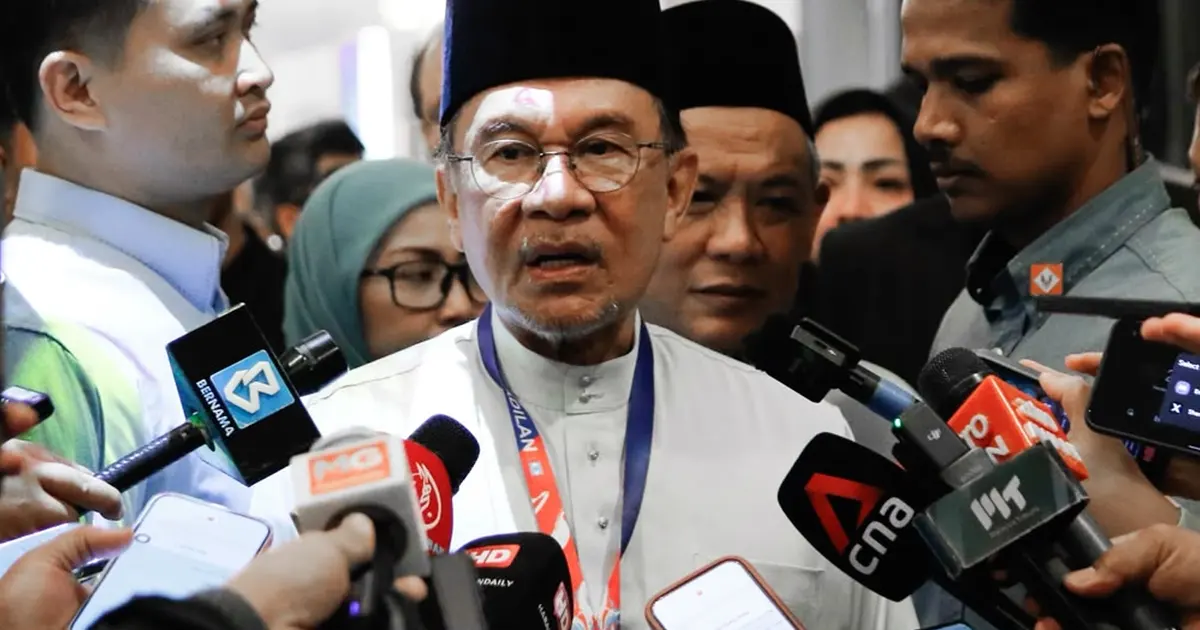
Prime Minister Anwar Ibrahim has moved to defuse speculation about potential friction within his administration by clarifying that he maintains sound working relations with Deputy Prime Minister Zahid Hamidi, dismissing recent commentary from former Umno Youth chief Khairy Jamaluddin as merely reflecting the ex-minister's personal interpretation of events rather than indicating actual trust deficits between the two senior leaders.
Anwar's remarks come in direct response to Khairy Jamaluddin's podcast comments, wherein the prominent Umno figure aired concerns about the state of confidence between the prime minister and his deputy. By framing KJ's observations as a singular perspective rather than objective commentary on coalition dynamics, Anwar sought to minimize the potential political damage of having such doubts publicly articulated by a seasoned party operative with considerable influence within Umno circles.
The prime minister's defensive posture underscores the delicate equilibrium required to maintain coalition stability in Malaysia's complex political landscape. The Barisan Nasional-Pakatan Harapan arrangement already faces inherent tensions given the historical adversarial relationship between Umno and PKR, and any perception of discord at the highest levels could embolden internal critics or opposition parties seeking to exploit cracks in the government's foundation. Anwar's swift clarification signals awareness of this vulnerability.
KJ's willingness to air such observations publicly, even through the relatively informal medium of a podcast, represents a notable shift in how Malaysian political figures communicate concerns about coalition management. Unlike traditional backroom negotiations or confidential discussions, this semi-public airing of trust issues reaches a broader audience and potentially influences media narratives around government stability. Anwar's framing of these comments as KJ's personal take attempts to contain the narrative fallout.
The episode also reflects ongoing tensions within Umno itself, where multiple factions maintain distinct perspectives on the party's role within the current government arrangement. Khairy Jamaluddin, who lost his position as Umno Youth chief and subsequently faced political setbacks, may harbor concerns about the direction of coalition politics that differ from those held by Zahid Hamidi, who secured advancement through the arrangement. Such internal party divisions can quickly manifest as public disputes if not carefully managed.
For Malaysian observers, the incident highlights the ongoing precarious nature of consensus-based governance that characterizes the current administration. Unlike single-party dominance, coalition governments require continuous accommodation of competing interests, and even routine disagreements over strategic direction can be weaponized as evidence of systemic dysfunction. Anwar's intervention effectively attempts to reframe KJ's comments as noise rather than signal.
The prime minister's assertion that the two leaders simply possessed different perspectives on the matter suggests a diplomatic solution rooted in relativism rather than factual reconciliation. Whether substantive trust issues exist between Anwar and Zahid remains unclear from this exchange, but the framing allows both leaders to maintain public confidence while avoiding direct confrontation. This approach preserves unity for consumption by both coalition partners and the broader electorate.
For Southeast Asian regional observers, Malaysia's coalition management carries implications beyond domestic politics. A government perceived as internally divided or lacking cohesion may face challenges in executing medium and long-term policy initiatives, particularly those requiring sustained commitment across multiple electoral cycles. Foreign investors and regional partners monitor such political stability signals closely when assessing the reliability of Malaysian commitments.
The controversy also illustrates the contemporary challenge facing Malaysian political communication, where traditional gatekeeping mechanisms have eroded substantially. Khairy Jamaluddin's ability to publicize concerns through podcast platforms means senior figures can no longer rely on confidentiality to contain sensitive discussions. This democratization of political commentary requires more sophisticated crisis response strategies from government leaders.
Moving forward, the incident provides a case study in how Malaysian politicians navigate the tension between transparency and discretion. While Anwar's clarification may satisfy immediate demands for reassurance, the underlying structural challenges that prompted KJ's observations—coalition friction, factional differences within Umno, and competing visions for government direction—remain unresolved. The prime minister's diplomatic response addresses the symptom rather than the underlying condition.
For domestic audiences, Anwar's measured response suggests confidence in the coalition's durability despite acknowledged differences among partners. His willingness to engage directly with KJ's claims, rather than dismiss them outright or respond with hostility, signals maturity in coalition management. However, the frequency with which such reassurances become necessary may itself indicate underlying structural vulnerabilities that periodic diplomatic clarifications cannot permanently resolve.

