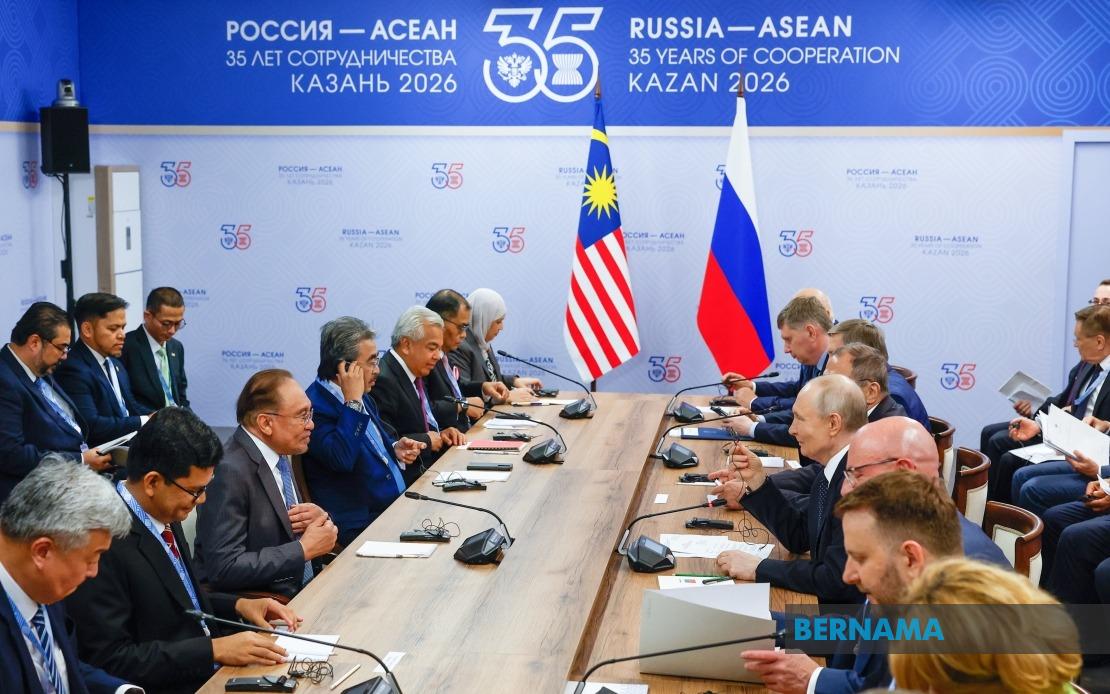
During an exclusive interview with Russian state television network RT in Kazan, Malaysian Prime Minister Datuk Seri Anwar Ibrahim articulated strong support for the peace positions adopted by Russia and China regarding the escalating Middle East crisis, distinguishing their approach from what he characterised as Western double standards on regional conflict.
Anwar was in Russia attending the Commemorative Summit celebrating the 35th anniversary of ASEAN-Russia relations when he sat down with RT to discuss Malaysia's diplomatic engagement on the Gaza conflict, Iranian tensions and the Lebanese situation. His commendation of Putin and Xi Jinping reflected Malaysia's broader strategic positioning in a multipolar world where major powers are increasingly competing for influence across Asia and beyond. The Prime Minister's willingness to publicly acknowledge these leaders' stances on Middle Eastern affairs signals Kuala Lumpur's confidence in maintaining substantive relationships with Moscow and Beijing while simultaneously engaging with Western capitals.
Central to Anwar's argument was Malaysia's rejection of what he termed the false binary choice between alignment with superpowers and principled silence on human rights violations. He explained that Malaysia has consistently taken a firm position against the Zionist regime's actions while preserving its independence from any superpower's sphere of influence. This stance has been demonstrated through parliamentary action, where Anwar noted that Malaysia passed bipartisan decisions opposing initial Israeli attacks, decisions described as receiving support from the United States. Such domestic political consensus underscores the depth of Malaysian public concern about Middle Eastern developments and the cross-party nature of the country's foreign policy orientation.
Anwar's framing of Malaysia's position as one of "centrality" rather than "neutrality" represents a meaningful conceptual distinction that carries implications for how Southeast Asia navigates great power competition. The Prime Minister emphasised that centrality means refusing to be tethered to any particular ideological camp or superpower while simultaneously refusing to remain silent when human rights abuses occur. This formulation allows Malaysia and ASEAN more broadly to maintain pragmatic relationships with multiple powers without compromising moral authority or internal consistency. For Malaysian readers, this distinction matters because it suggests the government believes it can engage meaningfully with Russia and China on Middle East issues without sacrificing relationships with Western partners or compromising its stated commitment to international law and human rights.
The Prime Minister's emphasis on extensive diplomatic engagement reflected the scope of Malaysia's shuttle diplomacy on Middle Eastern questions. Beyond Russia and China, Anwar reported active engagement with leaders from the Gulf states, Pakistan, Turkey and Iran as part of coordinated efforts to identify pathways toward fair resolution of the conflict. This multifaceted approach demonstrates that Malaysia views itself as a legitimate voice in regional peace processes, leveraging its position as a major Muslim-majority democracy with credibility across diverse constituencies. The geographic spread of his consultations from the Arabian Peninsula through South Asia and into the Eastern Mediterranean indicates that Kuala Lumpur sees the various conflicts as interconnected challenges requiring comprehensive diplomatic responses.
Yet the Prime Minister reserved his sharpest criticism for what he described as Western hypocrisy in selectively applying principles of international law and state sovereignty. Anwar posed a pointed question about how the international community could simultaneously espouse support for national independence while condoning Israeli military actions backed by the United States against other sovereign nations. He extended this criticism to encompass the broader ramifications spreading across the Gulf region and affecting global stability, moving beyond merely economic calculations to fundamental questions about the consistency of international norms. This critique carries particular resonance for Malaysian audiences given the country's historical experience as a postcolonial state that has consistently advocated for respect for national sovereignty and opposition to great power intervention in regional affairs.
The Prime Minister acknowledged that while some observers might level criticism at Iran's responses to regional developments, such scrutiny should not come coupled with international silence regarding aggression targeting Iran itself. He identified this asymmetry—where Western powers and their allies openly condemn Iranian actions while remaining largely mute about attacks on Iran—as emblematic of the hypocrisy he believes undermines international law and principles. For Malaysian policymakers and the broader Southeast Asian strategic community, this observation touches on legitimate concerns about how international norms are applied inconsistently depending on the geopolitical interests of powerful states, a dynamic that directly affects smaller nations' security and autonomy.
Anwar's public commendation of Putin and Xi Jinping on peace advocacy should be understood within the context of Malaysia's broader hedging strategy in an era of great power rivalry. By publicly acknowledging Russian and Chinese positions on Middle Eastern conflicts, the Prime Minister signals to both Moscow and Beijing that Malaysia values their participation in international diplomacy and appreciates their stated commitment to peaceful resolution. Simultaneously, such statements serve domestic constituencies in Malaysia that view Western military interventions with suspicion and appreciate leadership that vocally defends Muslim-majority nations against what they perceive as unjust external pressure or military action.
The interview itself demonstrated the importance Malaysia places on communications channels with major powers beyond traditional Western diplomatic venues. The choice to grant an exclusive interview to RT, a Russian state media organisation, rather than relying solely on traditional Western media outlets for articulating Malaysia's foreign policy positions, reflects a deliberate effort to ensure that Malaysian perspectives reach diverse global audiences and are not filtered through primarily Western media interpretations. This media strategy aligns with Malaysia's broader effort to operate within multiple information ecosystems and maintain independent channels for diplomatic messaging.
For the Malaysian public and policymaking community, Anwar's comments underscore the government's commitment to maintaining its independent foreign policy orientation despite pressures toward alignment with particular blocs. The emphasis on centrality rather than neutrality provides intellectual cover for a foreign policy approach that appears pragmatic to some observers and principled to others, depending on one's assessment of whether Malaysia's positions on specific conflicts genuinely reflect moral commitments or strategic calculations. The government's public engagement with Chinese and Russian positions on Middle Eastern affairs while continuing to maintain relationships with Western partners suggests confidence in Malaysia's ability to navigate multiple great power relationships without irreversible commitment to any single camp.
The broader context of these statements within the ASEAN-Russia commemorative summit also merits consideration, as it reflects the regional organisation's effort to maintain substantive engagement with major powers across the Asia-Pacific and beyond. Malaysia's articulation of ASEAN's centrality principle, through the voice of its current Prime Minister, contributes to a broader regional narrative about Southeast Asian agency and independence in international affairs. As the region continues to grapple with great power competition, technological change, and economic interdependencies that blur traditional alignment categories, Malaysia's insistence on the possibility of maintaining principled independence while engaging multiple powers carries significance for how other Southeast Asian nations conceptualise their own strategic autonomy in an increasingly complex international environment.

