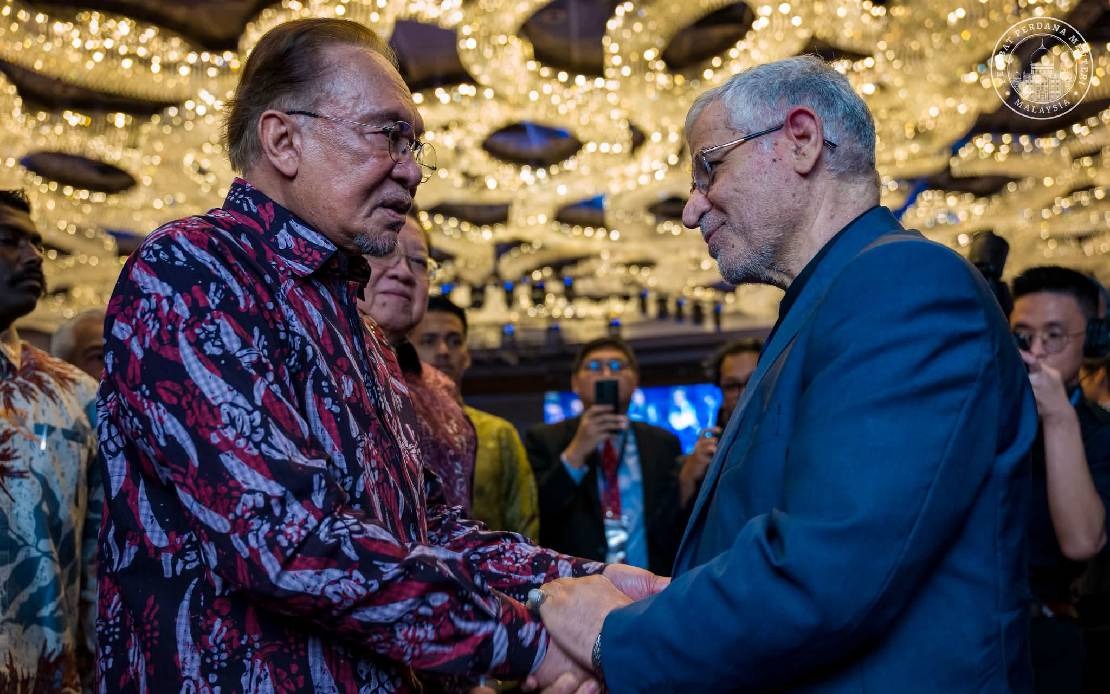
Prime Minister Datuk Seri Anwar Ibrahim has conveyed formal regrets to the Iranian Government regarding his absence from the state funeral and farewell ceremonies honouring the late Supreme Leader Ayatollah Ali Khamenei. The apology was communicated during a bilateral meeting between Anwar and Iranian Ambassador to Malaysia Valiollah Mohammadi at the 39th Asia-Pacific Roundtable conference in Kuala Lumpur on July 2, with the Prime Minister sharing his condolences via social media to both the Iranian Government and people following Khamenei's death.
Anwar explained that prior official commitments rendered his personal attendance at the ceremonial events impossible, despite the significance of the occasion. Rather than leave Malaysia's diplomatic representation vacant, the Prime Minister directed Agriculture and Food Security Minister Mohamad Sabu to serve as Malaysia's official representative at the funeral proceedings, ensuring the country maintained an appropriate presence at the funeral rites.
Ayatollah Ali Khamenei, who was 86 years old, passed away on February 28 at his residence in central Tehran following a combined military offensive by the United States and Israel. His death marked a watershed moment in Iranian politics and Middle Eastern affairs, given his role as the Islamic Republic's highest-ranking authority and spiritual leader since 1989. The Supreme Leader's demise carried profound implications not only for Iran's domestic governance but also for regional geopolitical dynamics and international relations across the Muslim world.
The funeral and farewell proceedings were scheduled as an expansive six-day ceremonial observance commencing on July 4. The events were designed to reflect the stature and significance of Khamenei's position within Iran's religious and political hierarchy. The schedule included multiple funeral processions through Tehran and Qom, two of Iran's most important cities religiously and symbolically, with the final burial taking place at the Imam Reza Shrine in Mashhad on July 9, one of Shia Islam's holiest sites.
This diplomatic gesture by Anwar underscores Malaysia's commitment to maintaining constructive bilateral relations with Iran despite competing international pressures. Malaysia, as a Muslim-majority nation with strategic interests in the Middle East, has historically balanced its relationships across the region while maintaining diplomatic channels with various powers. The deliberate communication of the Prime Minister's apology through formal channels and public acknowledgement demonstrates sensitivity to diplomatic protocol and respect for Iran's sovereignty during a period of national mourning.
The presence of a ministerial-level representative reflected the importance Malaysia placed on honouring its relationship with Tehran. Mohamad Sabu's attendance signified that whilst scheduling constraints prevented Anwar's participation, Malaysia regarded the occasion sufficiently significant to dispatch a senior cabinet member. This calculated approach allowed Malaysia to demonstrate solidarity with Iran's Islamic leadership while managing the Prime Minister's other critical state responsibilities.
The timing of Khamenei's death during what appeared to be escalating regional tensions highlighted the volatile nature of Middle Eastern geopolitics. For Southeast Asian nations like Malaysia, developments in Iran carry implications for regional security, international commerce, and the broader Islamic world's stability. Malaysia's measured diplomatic response—combining personal regret with substantive representation—reflected the nuanced balancing act required of regional powers navigating relationships across competing geopolitical blocs.
Anwar's specific mention of unavoidable official commitments, whilst not elaborated, implicitly acknowledged that Malaysian affairs of state could not be deferred. This reality illustrated the demanding nature of prime ministerial office, where international ceremonial obligations sometimes conflict with domestic governance responsibilities. The decision to depute ministerial representation rather than send lower-ranking officials demonstrated respect for the occasion's gravity.
For Malaysian observers, this incident illustrated how Southeast Asian nations maintain diplomatic engagement with major Islamic powers whilst managing complex international relationships. The funeral proceedings in Iran would attract leaders and dignitaries from across the Islamic world, each navigating similar considerations of political relationships, scheduling constraints, and diplomatic signalling. Malaysia's approach—balancing respect, representation, and practical constraints—exemplified the sophisticated diplomacy required in contemporary international relations where religious, political, and strategic interests frequently intersect.

