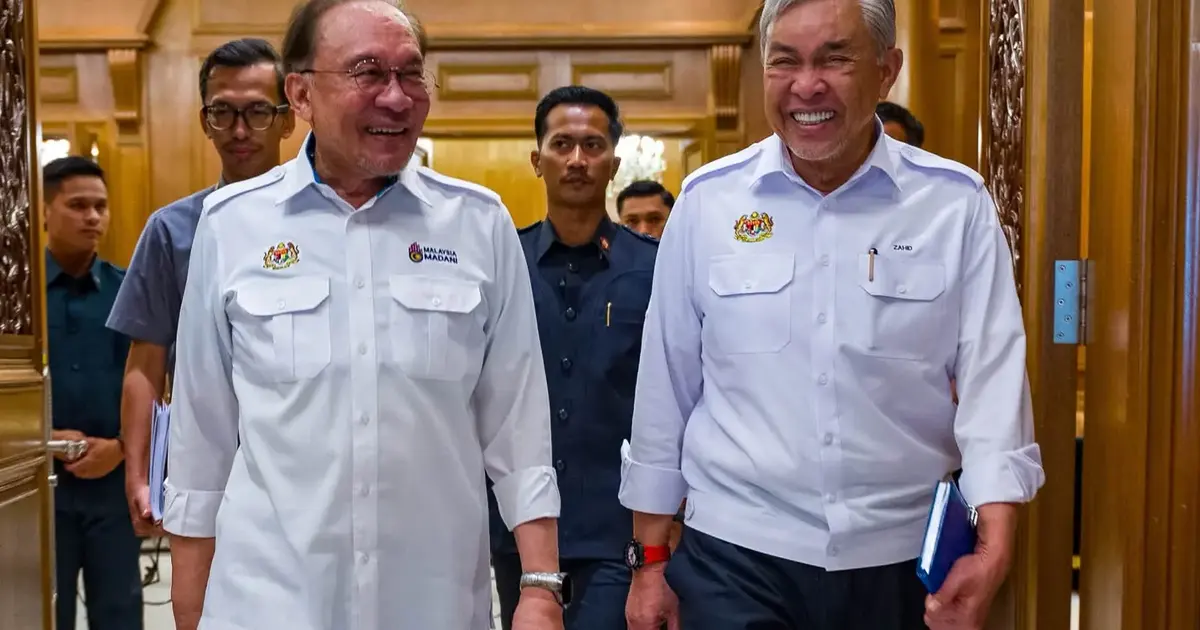
The Malaysian political leadership has moved swiftly to defuse tensions that briefly threatened to roil the country's ruling coalition, with Prime Minister Anwar Ibrahim and Barisan Nasional chairman Ahmad Zahid Hamidi presenting a united front following a charged verbal exchange that raised questions about the durability of their alliance.
The two leaders, photographed together with evident goodwill, sought to reassure their respective factions and the broader political establishment that disagreements within the coalition remain manageable and do not undermine the government's fundamental stability. The apparent harmony comes just a day after Zahid made pointed remarks suggesting that Anwar possessed the authority to dismiss eight ministers representing the Barisan component from the cabinet if dissatisfaction prompted such action.
Zahid's commentary, though phrased as a statement of fact regarding Anwar's executive prerogatives, carried unmistakable undertones of tension within a coalition government that has navigated considerable internal friction since its formation. The Barisan chairman's reference to these ministers—drawn from the party's ranks to bolster the administration's parliamentary representation—highlighted the underlying dependency dynamics that characterise many coalition arrangements in Malaysia's political system.
The swift softening of rhetoric from both sides demonstrates the pragmatic considerations that dominate Malaysian coalition politics. Neither leader benefits from prolonged public acrimony, particularly when broader governance challenges demand sustained political focus. The government faces mounting economic pressures, demanding parliamentary attention, and potential mid-term fiscal adjustments that require unwavering coalition cohesion to advance.
Anwar's government depends substantially on Barisan Nasional's parliamentary numbers, making the relationship between the two institutions critical for legislative effectiveness. The Barisan ministers represent not merely individual appointments but rather symbols of the broader coalition understanding that underpins executive stability. Any serious conflict over their status would signal deeper fractures that could invite speculation about the government's longevity.
This pattern of tension followed by reconciliation has become increasingly familiar in Malaysian governance over recent years. Coalition partners frequently engage in public posturing—ostensibly negotiating over ministerial portfolios, policy directions, or resource allocation—before returning to cooperative frameworks. These episodes serve multiple functions, allowing each faction to demonstrate strength to its supporters while ultimately reaffirming shared interests in remaining within the governing coalition rather than risking opposition status.
For Malaysian observers and the business community, such political theatre carries genuine implications. Market confidence depends significantly on perceptions of governmental stability and the ability of the coalition to function coherently across contentious issues. Episodes of public conflict, even when resolved quickly, create temporary uncertainty that can affect investment decisions and policy implementation timelines.
The underlying structural issue remains relevant regardless of immediate reconciliation. The Barisan Nasional, representing Malaysia's traditional political establishment, has adapted to a subordinate role within coalition arrangements that would have been unthinkable during its decades of dominance under different electoral configurations. Managing this adjustment while maintaining party cohesion and member satisfaction requires careful navigation from both Zahid and party leadership.
Anwar's position as Prime Minister carrying the numerical advantage of his own faction provides inherent authority in such negotiations, yet coalition stability depends on exercising that authority with restraint. The theatrical assertion by Zahid that ministerial dismissals remain possible may have represented reassurance to his own supporters that the Barisan retains leverage and respect, even if formal authority rests elsewhere.
Southeast Asia's broader political environment also influences such dynamics. Regional governments continuously balance factional interests with governance imperatives as coalition arrangements have become increasingly common across the region. Malaysia's coalition structure, though often fractious, has provided continuity that rival political arrangements might not have sustained through comparable economic and social challenges.
Looking forward, observers will likely witness additional cycles of tension and reconciliation within this coalition framework. The fundamental question remains whether these periodic friction points represent healthy political contestation within a stable system or whether they foreshadow deeper structural fragmentation. For now, the public reconciliation between Anwar and Zahid suggests the government leadership believes continuing cooperation serves all parties' interests better than the alternative risks entailed in governmental collapse.
The stability conveyed through their smiling appearance together carries material weight in Malaysian politics, where perceptions of unity often matter as much as substantive policy alignment. As the government tackles ongoing economic headwinds and legislative responsibilities, the coalition's ability to present itself as functional and purposeful remains essential to its effectiveness and longevity.

