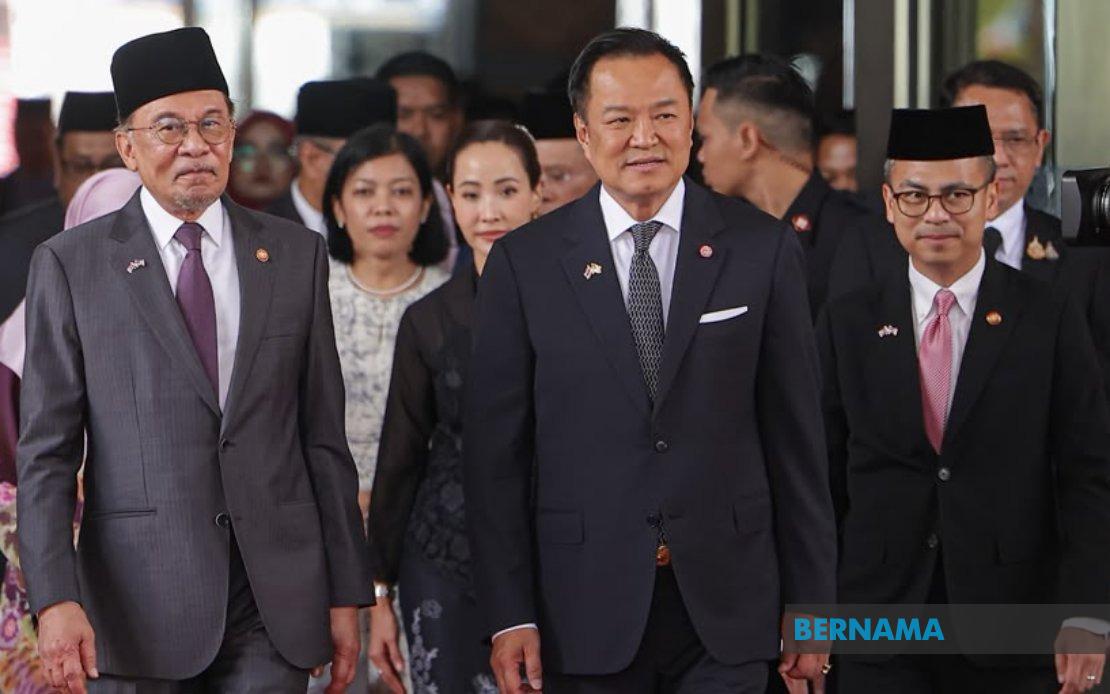
Prime Minister Datuk Seri Anwar Ibrahim and Thailand's Prime Minister Anutin Charnvirakul convened for high-level talks at the Perdana Putra Complex in Putrajaya on July 9, marking a significant moment in bilateral relations between Southeast Asia's two major economies. The meeting underscored the commitment of both nations to deepen engagement across multiple sectors, reflecting a strategic priority for Malaysia and Thailand as they navigate evolving regional dynamics and economic challenges.
Anutin arrived at Kuala Lumpur International Airport at 11.11 am, where Anwar received him with full ceremonial honours at the Bunga Raya Complex before both delegations moved to the seat of Malaysia's government. The Thai premier was visiting Malaysia on a formal two-day trip, highlighting the significance both capitals place on maintaining robust diplomatic channels and demonstrating renewed momentum in their relationship after months of routine engagement.
The agenda encompassed a comprehensive sweep of bilateral interests that reflects contemporary priorities for both nations. Trade and investment featured prominently, as Malaysia and Thailand seek to expand their economic footprint amid intensifying regional competition and global supply chain reconfiguration. Border connectivity was another critical discussion point, given that the two countries share a lengthy maritime boundary and face shared challenges in securing key waterways and facilitating seamless cross-border movement of goods and people. The inclusion of security matters signals mutual concerns about transnational threats, maritime security in the region, and coordination on issues affecting their shared interests.
Agriculture represented a particularly substantive area for discussion. Both nations are agricultural exporters with overlapping interests in rice production, palm oil, and other commodities. Strengthening cooperation in this sector could help both countries manage market volatility, improve supply chain resilience, and invest jointly in agricultural innovation. Tourism, another cornerstone of Southeast Asian economies, provided an opportunity to discuss recovery strategies and marketing initiatives in a post-pandemic landscape where visitor numbers remain a priority for both governments.
Educational exchanges and people-to-people connectivity underscore the softer dimensions of the relationship—building long-term understanding and cultural bridges between Malaysian and Thai citizens. These initiatives create constituencies for good relations at the grassroots level and foster human capital development through scholarship programmes and institutional partnerships.
The bilateral discussion naturally extended to regional and international issues examined through the lens of ASEAN and broader mechanisms. This reflects both nations' shared commitment to the Association's centrality in addressing regional security, economic integration, and diplomatic coordination. As middle powers within the grouping, Malaysia and Thailand have mutual interests in upholding ASEAN's collective voice in dealing with major powers and managing contested issues such as the South China Sea disputes.
Malaysia's delegation featured an unusually comprehensive cabinet attendance, underscoring the governmental priority attached to the engagement. Deputy Prime Minister Datuk Seri Fadillah Yusof, Foreign Minister Datuk Seri Mohamad Hasan, Transport Minister Anthony Loke, Minister of Agriculture and Food Security Datuk Seri Mohamad Sabu, Home Minister Datuk Seri Saifuddin Nasution Ismail, and Minister of Investment, Trade and Industry Datuk Seri Johari Abdul Ghani all attended. This breadth of ministerial participation allowed substantive discussions on sectoral issues and demonstrated that the engagement transcended ceremonial protocol to address substantive policy coordination.
Thai representation was equally substantial. Thailand deployed Deputy Prime Minister Sihasak Phuangketkeow, who also leads the foreign ministry, alongside fellow Deputy Prime Ministers Phiphat Ratchakitprakarn and Ekniti Nitithanprapas, signalling Thailand's own commitment to the talks. The inclusion of Thailand's transport, tourism, defence, agriculture, and labour ministers reflected Bangkok's understanding that Malaysia-Thailand cooperation spans technical and operational domains requiring high-level policy direction.
A significant outcome emerging from the bilateral meeting was the anticipated signing of a Memorandum of Understanding on agricultural cooperation. This formal instrument would codify the two countries' commitment to systematic collaboration in the agricultural sector, potentially opening pathways for joint research, technology transfer, market access arrangements, and capacity building. For Malaysian readers, this development carries particular relevance given agriculture's importance to rural economies and food security strategies, while Thai farmers would benefit from enhanced market opportunities and technological spillovers.
The bilateral meeting structure—culminating in an official luncheon hosted by Anwar—followed established diplomatic protocols that emphasize the personal dimension of high-level statecraft. Such occasions provide informal settings where leaders can discuss sensitive matters with greater candour and build the personal rapport that often underpins successful bilateral relations. In the Malaysian-Thai context, where relations have occasionally experienced friction over maritime boundaries, irregular migration, and resource management, such face-to-face engagement serves an important confidence-building function.
For Malaysia's broader foreign policy, the Anutin visit represented an opportunity to reinforce ties with a neighbouring country where strategic interests converge. Thailand remains important for Malaysia's regional positioning, trade flows, and coordination on security challenges. Similarly, Bangkok views Malaysia as a key partner in promoting regional stability and managing shared concerns about maritime security and economic interdependence.
The comprehensiveness of the bilateral agenda and the high-level attention devoted to the visit suggest that Malaysia-Thailand relations are entering a phase of more deliberate strategic coordination. Rather than allowing ties to rest on historical momentum and geographic proximity, both governments appear committed to institutionalizing cooperation and identifying new frontiers for partnership. This approach reflects the reality that regional competition is intensifying, and nations must actively cultivate relationships to remain mutually relevant.

