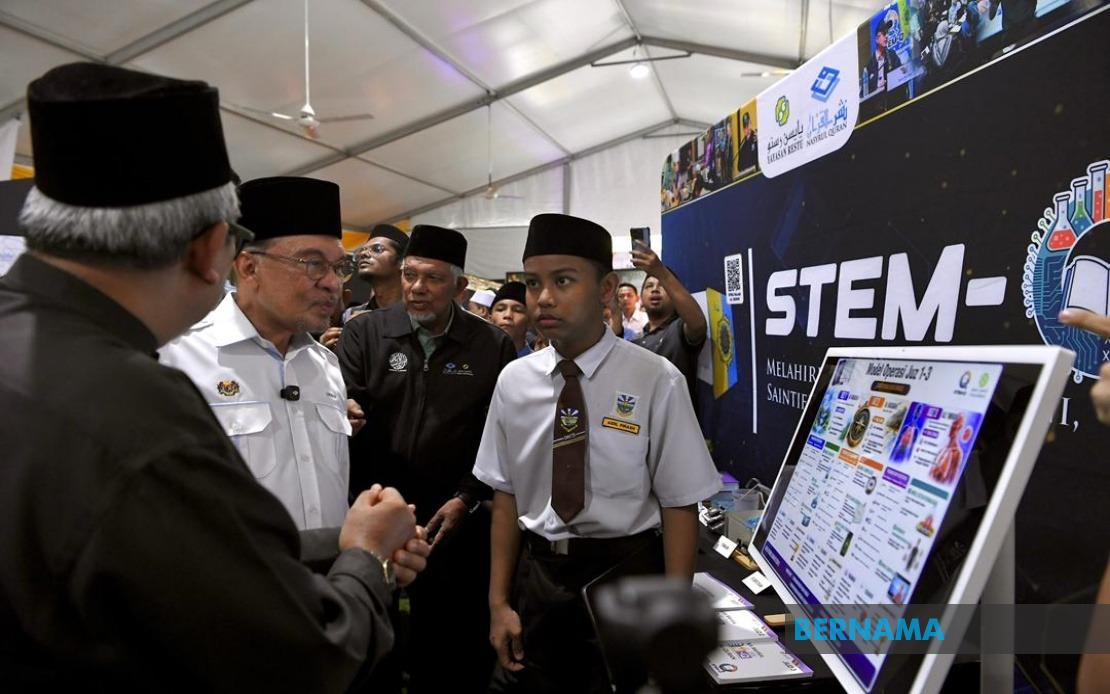
Prime Minister Datuk Seri Anwar Ibrahim has approved RM4.6 million in fresh funding this year to strengthen the physical infrastructure of 27 Islamic educational institutions throughout Penang, signalling the government's deepening commitment to religious education facilities across the northern state. The announcement, made during his address at the National Tadabbur Perdana and Maidah Wanita MADANI Permatang Pauh programmes at Masjid Muhajirin in Butterworth, represents a substantial increase from the RM2.11 million disbursed in the previous year for similar upgrading works at 11 institutions.
The expansion of funding underscores a strategic pivot towards broadening support for Islamic learning infrastructure beyond individual institutions to a more comprehensive network. Anwar, speaking in his dual capacity as Prime Minister and Finance Minister, outlined the diverse applications of the allocation, which encompasses foundational structural improvements such as boundary walls and fencing, essential infrastructure repairs at madrasahs and conventional schools, construction of new kindergarten facilities, and expansion of tahfiz academy capacity. This diversified approach reflects recognition that Islamic education infrastructure requires multifaceted investment spanning early childhood development through advanced Quranic memorisation programmes.
The doubling of the allocation from the previous fiscal year demonstrates accelerated government responsiveness to the needs articulated by religious institutions in Penang. Rather than adopting a one-size-fits-all approach, the government has expanded its reach to encompass a broader spectrum of facilities, suggesting improved coordination with state-level religious authorities and community stakeholders in identifying priority infrastructure gaps. For Malaysian policymakers, this represents a practical model of resource distribution that balances fiscal discipline with targeted sectoral investment.
Beyond the immediate infrastructure improvements, Anwar emphasised the government's broader strategic objective of fortifying Islamic educational facilities nationwide as a cornerstone of the country's religious development agenda. He positioned the infrastructure investment within a larger framework of institutional strengthening, arguing that robust physical facilities form the foundation upon which quality religious instruction can flourish. This holistic perspective recognises that overcrowded or deteriorating learning environments undermine pedagogical effectiveness regardless of curriculum quality.
A significant dimension of Anwar's remarks addressed the intersection of traditional Islamic education with contemporary technological advancement. He advocated for integrating artificial intelligence and digital tools into Quranic and Islamic studies methodologies, acknowledging that religious institutions cannot remain insulated from the technological transformations reshaping global education. This stance positions Malaysia within broader conversations occurring across the Muslim world regarding how to harness technology's potential while preserving religious values.
However, the Prime Minister introduced a crucial caveat to his technology advocacy, insisting that artificial intelligence implementation must remain subordinate to ethical frameworks and moral governance structures. His articulation that AI "must have values" and be "rooted in morality" signals concern about unfettered technological adoption that prioritises skill development and efficiency gains while neglecting character formation and spiritual development. This distinction carries particular weight in Islamic education contexts, where moral and spiritual dimensions are understood as inseparable from knowledge acquisition.
Anwar's call for continuous expansion of community-organised religious programming addresses a gap in formal institutional education by mobilising grassroots religious engagement. His encouragement of sustained Quranic study circles, tadabbur reflection sessions, and religious lectures reflects understanding that religious literacy deepens through repeated exposure and communal reinforcement rather than exclusive reliance on institutional curricula. By framing these programmes as mechanisms for clarifying authentic Islamic teachings against potential distortions, he positioned religious education as a safeguard against ideological drift.
The emphasis on enabling the public to organise religious programmes within the freedoms available in the Malaysian constitutional framework carries implications for how religious education is understood in secular democracies. Rather than positioning government-led initiatives as the exclusive pathway for religious advancement, Anwar highlighted the complementary role of voluntary community action, suggesting a nuanced governance approach that neither crowds out civil society participation nor abdicates government responsibility.
For Penang specifically, the allocation carries particular significance given the state's multi-religious composition and its position as a regional economic hub where educational quality directly influences migration patterns and community stability. The investment signals that despite Penang's secular governance, recognition exists at the federal level that adequate religious education infrastructure constitutes part of comprehensive social provision that supports diverse community needs.
The infrastructure improvements targeted at Islamic institutions parallel broader government priorities evident across portfolio allocations, suggesting that religious education infrastructure has secured stable position within budgetary hierarchies. The progression from RM2.11 million to RM4.6 million across consecutive years indicates this is not a one-time gesture but potentially a trajectory reflecting expanding policy commitment. Observing whether this pattern continues in subsequent budget cycles will clarify whether infrastructure support for Islamic institutions is becoming institutionalised within government spending frameworks.
The integration of technology capacity-building with traditional infrastructure provision positions Malaysian Islamic institutions within global networks exploring how religious education modernises while maintaining doctrinal integrity. As other countries grapple with similar questions, Malaysia's approach may offer comparative lessons regarding governance frameworks that simultaneously support religious autonomy and technological capability advancement. The Penang allocation thus represents more than budget redistribution; it signals philosophical orientation towards religious institutions as worthy of sustained strategic investment in an increasingly digitised educational landscape.

