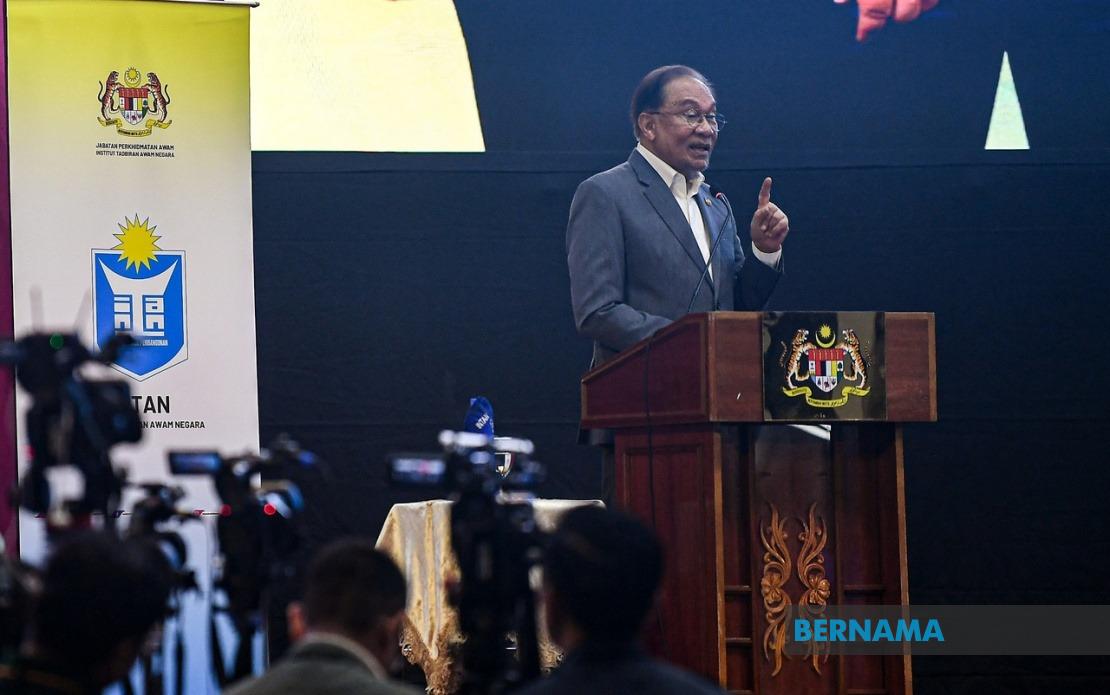
Prime Minister Datuk Seri Anwar Ibrahim has offered a qualified apology for the intensity of his messaging when addressing civil servants at various official engagements, framing his stern approach as a reflection of his personal investment in the nation's development agenda. Speaking to officials from the Central Zone at Universiti Islam Selangor alongside Chief Secretary to the Government Tan Sri Shamsul Azri Abu Bakar, Anwar acknowledged that multiple people had counselled him about moderating his tone now that he holds the highest executive office, yet he stopped short of committing to wholesale changes to his communication style.
The Prime Minister's remarks, shared through a Facebook video, represent a careful calibration between accepting legitimate feedback about presidential decorum and defending his right to speak with conviction on matters he considers fundamental. This nuanced position reveals the tension between Anwar's established reputation as a passionate, often forceful advocate and the expectations that come with leading a nation of 34 million people. His acknowledgment that "sometimes, when issues touch my heart and emotions, I need to speak out" suggests he views emotional authenticity as more valuable than projecting an image of studied calm.
Anwar's defence of his approach centres on the principle that civil servants, as the backbone of government implementation, merit his most direct and unfiltered communication. By characterising the bureaucracy as "my own team" and "the machinery responsible for ensuring the success of our nation's programmes and policies," he positioned his critical tone not as harshness directed at subordinates, but as investment in their capacity to deliver. This rhetorical move transforms what critics might view as unpresidential conduct into evidence of his commitment to governmental effectiveness rather than performative leadership.
The timing of this statement carries significance within Malaysia's political context. Anwar's administration has prioritised sweeping civil service reform and accelerated policy implementation since taking office, with the bureaucracy identified as a crucial partner in meeting the government's modernisation targets. Any perception that the Prime Minister is at odds with senior officials could undermine the unity required for such ambitious initiatives. By apologising conditionally while reaffirming his conviction, Anwar attempts to preserve his authority to demand rigorous performance without allowing critics to characterise his leadership as erratic or temperamental.
Civil service management in Malaysia has historically been a sensitive domain, with debates over meritocracy, political neutrality, and the relationship between elected leaders and career officials occurring regularly at the highest levels. Anwar's willingness to address public criticism about his communication style suggests he recognises that leadership style matters as much as policy substance in maintaining institutional morale and public confidence. The fact that such matters reach the Prime Minister's office through multiple channels indicates that his tone has generated genuine concern among officials and observers alike.
The Central Zone gathering where these remarks occurred represents an important constituency for any Malaysian administration, encompassing Kuala Lumpur and the surrounding federal territories. These officials oversee policy implementation affecting the nation's economic hub, making their engagement and commitment essential to the government's success. Anwar's address to this specific group, therefore, carried implications beyond mere personnel management, touching on the broader relationship between political leadership and administrative machinery in Malaysia's governance structure.
Anwar's framing of emotional expression as a leadership strength rather than a weakness reflects a particular philosophy of political authenticity that has characterised his career. Rather than presenting himself as an aloof administrator managing a system from above, he positions himself as someone operating from conviction and moral purpose. This approach resonates with supporters who value passion and commitment over procedural polish, yet simultaneously creates friction with those who believe executive authority requires emotional restraint and professional distance.
The apology's conditionality—apologising only if his tone "was perceived" as harsh rather than conceding that it objectively was—preserves Anwar's rhetorical ground while offering a gesture toward his critics. This careful phrasing allows him to acknowledge concerns without accepting blame, a distinction that matters in Malaysian political discourse where perceived weakness can quickly translate into diminished authority. The reliance on perception rather than objective assessment also implicitly invites sympathetic audiences to question whether his tone was genuinely problematic or merely unconventional for a prime minister.
For Malaysian civil servants watching this exchange, the message appears mixed. Anwar has signalled that emotional intensity and firm messaging remain hallmarks of his leadership style, suggesting that those working directly with him should expect passionate engagement rather than detached formality. Simultaneously, his acknowledgment of criticism indicates that the government does monitor feedback about leadership effectiveness and is willing to engage with concerns raised by the bureaucratic establishment. This balancing act may ultimately strengthen Anwar's position by allowing him to maintain his characteristic directness while demonstrating responsiveness to institutional feedback.
The broader implications extend to how Malaysian government functions during periods of significant reform. When political leaders adopt stern communication styles while pursuing ambitious policy agendas, the distinction between rigorous oversight and counterproductive intimidation becomes crucial. Anwar's conditional apology, viewed through this lens, represents an attempt to occupy the space between these poles—remaining uncompromisingly demanding while acknowledging that leadership style affects institutional health and public perception.

