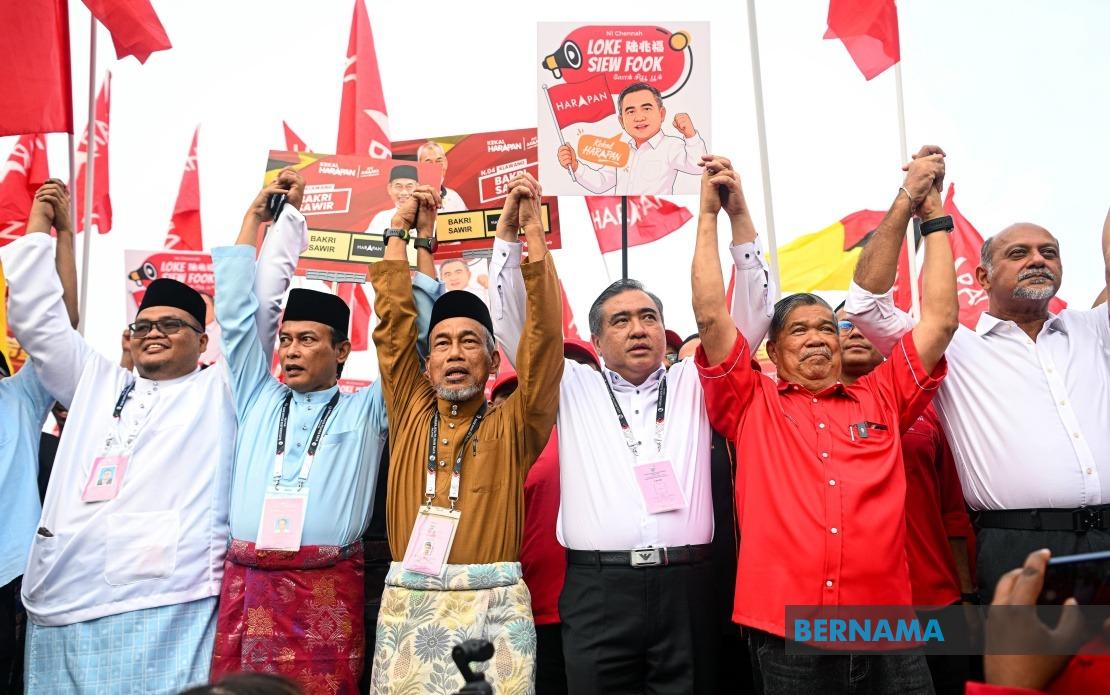
Transport Minister Anthony Loke faces a formidable challenge to retain the Chennah state seat he has represented since 2013, as the DAP secretary-general squares off against Barisan Nasional's candidate in what has crystallized into a straight two-way fight in the 16th Negeri Sembilan state election. The contest pits Loke, the influential Seremban Member of Parliament, against Siow Kong Choon, the state MCA Youth chief, in a matchup that exemplifies the broader coalition dynamics playing out across the state assembly polls.
Nomination day formalities concluded in Jelebu on Thursday with both candidates submitting their papers within minutes of each other, signalling a competitive race from the outset. Loke registered his nomination at 9.05 am, followed swiftly by Siow at 9.09 am. The rapid succession underscored the intensity of preparations for what has become one of the more closely watched contests in the Negeri Sembilan elections, with both camps mobilizing resources behind their respective candidates.
The Chennah seat carries particular significance within Negeri Sembilan's political landscape, having remained in DAP hands through Loke's tenure, which has spanned three consecutive state election cycles. His presence in the state assembly has made him a visible player in parliamentary politics, allowing him to combine his roles as both a state representative and federal minister. This dual positioning has traditionally worked in his favour, enabling him to channel development funding and secure federal support for the constituency.
Siow's candidacy represents BN's determination to recapture ground in Negeri Sembilan, where the coalition has experienced mixed fortunes in recent years. As state MCA Youth chief, Siow brings organizational experience within the Chinese-based component party, though MCA's electoral performance has been inconsistent at the state level. His nomination signals BN's tactical decision to deploy experienced party operatives rather than newcomers, reflecting confidence in the coalition's ability to compete in this seat.
The Electoral Commission has announced that early voting will occur on July 28, with the main polling scheduled for August 1. This timeline provides both campaigns with roughly two weeks to conduct ground operations, though candidates had begun campaigning informally since the state election was announced. The compressed campaign period heightens the importance of ground organization and voter contact strategies, areas where Loke's established machinery and Siow's party network will likely prove decisive.
Context from the previous state election reveals the competitive nature of this constituency. In the 2023 Negeri Sembilan state election, Loke accumulated 5,888 votes, defeating Perikatan Nasional candidate Rosmadi Arif with a majority of 2,200 votes. That result, while comfortable, did not represent an overwhelming mandate, suggesting underlying electoral volatility. The removal of PN as a challenger this time, with BN stepping into the main opposition role, fundamentally reshapes the political calculus.
The absence of a three-way contest fundamentally alters the electoral mathematics in Chennah. When PN competed in 2023, the opposition vote split between two challengers, which likely benefited Loke. Now, with a consolidated BN challenge, Siow effectively inherits not only PN's voter base but also gains access to the broader BN machinery and resources that extend beyond what MCA alone could mobilize. This consolidation represents the most significant tactical advantage for the opposition camp in this particular seat.
For Malaysian observers, the Chennah contest encapsulates broader questions about DAP's holding power in state assembly seats, particularly in constituencies with mixed demographics. Loke's profile as a prominent federal politician cuts both ways—while it provides visibility and access to resources, it can also invite criticism about divided priorities or perceived distance from grassroots concerns. His Transport Ministry portfolio, though nationally significant, offers limited direct constituency benefits compared to state-level portfolios controlling land, local government, or education matters.
The political atmosphere surrounding these elections reflects the continuing realignment of Malaysian politics following the 2022 general election. The PH-BN cooperation in federal government has created new dynamics at state level, though Negeri Sembilan has remained a competitive battleground where both coalitions mount serious challenges. The Chennah seat will serve as a barometer for broader voter sentiment regarding DAP representation and coalition preferences in this state.
Beyond the immediate contest, the election carries implications for how Negeri Sembilan positions itself within the broader Malaysian political landscape. The state has traditionally served as a swing constituency, and results will influence calculations about coalition strength heading into potential future federal electoral contests. For DAP, retaining Chennah would signal continued viability in state assembly representation outside their traditional strongholds in the peninsula's major urban centres.
Campaigners on both sides will likely focus on pocketbook issues affecting voters—cost of living, local infrastructure, education, and healthcare services. State assembly representatives, despite their lower public profile compared to federal politicians, handle numerous constituent concerns through their constituencies, making constituent service delivery a legitimate campaign issue. Both Loke's incumbency and Siow's representation of BN will be tested against voter expectations for tangible delivery.
The race also reflects generational considerations within MCA, with Siow representing the youth wing attempting to inject new energy into a party struggling with voter relevance among younger demographics. His candidacy represents an opportunity for MCA to demonstrate continued political utility within BN, particularly important for maintaining the party's position and resource allocation within the coalition structure.

