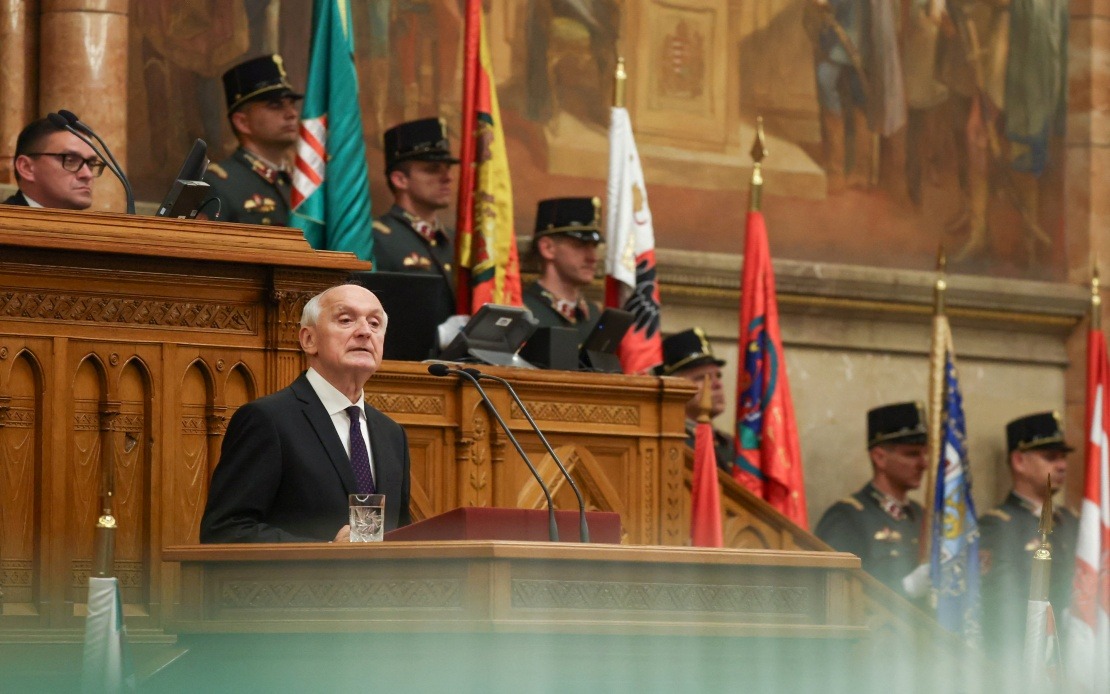
Andras Baka formally became Hungary's president on August 19, 2026, marking a significant transition in the nation's leadership. Prime Minister Peter Magyar confirmed the inauguration through a social media statement, extending congratulations to the newly sworn-in head of state and expressing hopes for his tenure to be characterised by humanitarian principles and effective governance.
The Hungarian Parliament had elected Baka to the presidency during a session held on August 11, bringing to a close a contentious electoral process that reflected deeper divisions within Hungarian politics. His appointment represents a pivotal moment for Central Europe's largest democracy, though it came amid considerable political controversy that threatened to undermine the legitimacy of the office itself.
Baka's ascent to the presidency caps a lengthy judicial career spanning multiple institutions and jurisdictions. Between 2009 and 2011, he served as president of Hungary's Supreme Court, a period that proved formative but ultimately disappointing for his judicial philosophy. His tenure coincided with the government of then-Prime Minister Viktor Orban, whose administration embarked on sweeping reforms of the nation's judicial architecture. Unable to reconcile his principles with the direction of these constitutional changes, Baka resigned from his position rather than preside over transformations he opposed.
Prior to his domestic judicial service, Baka worked at the European Court of Human Rights in Strasbourg, gaining experience in international human rights law and cross-border legal cooperation. This background positioned him as an advocate for judicial independence and protection of individual freedoms, values that later shaped his resistance to the Orban government's judicial overhauls. His stint in Strasbourg provided him with perspectives on European standards of justice and democratic governance that would inform his subsequent career decisions.
Following his resignation from the Supreme Court, Hungarian authorities reorganised the judiciary through constitutional reform. In place of the Supreme Court emerged the Hungarian Curia, a restructured institution intended to serve similar functions within the reformed judicial system. Demonstrating continued commitment to judicial work despite his earlier disappointments, Baka took on the role of chairman of the Hungarian Curia, a position he maintained from 2012 until 2020. His leadership of this institution allowed him to influence judicial policy during a critical period of organisational development, even as questions persisted about judicial independence under the broader Orban government framework.
The path to Baka's presidency proved contentious and fractious, revealing the polarised state of Hungarian politics. Major opposition forces, specifically the Fidesz party and the Christian Democratic People's Party, refused to participate in the presidential election. Their boycott constituted a direct protest against the removal of the previous president, Tamas Szujok, which had been accomplished through constitutional amendments. This dramatic step underscored opposition grievances about the manner in which constitutional changes were being deployed to reshape Hungary's political institutions.
The boycott by these significant political forces raises important questions about the legitimacy and stability of Hungary's institutional changes. When major opposition parties refuse to recognise or participate in electoral processes, it signals fundamental disagreement not merely about particular policies but about the constitutional framework itself. For Malaysia and other Southeast Asian democracies, Hungary's experience offers cautionary lessons about the dangers of using constitutional amendments to remove sitting officeholders, a practice that can corrode public confidence in democratic institutions.
Baka's election and inauguration occur against a backdrop of ongoing international scrutiny of Hungarian democratic standards. The European Union and various international observers have expressed concerns about judicial independence, media freedom, and constitutional governance in Hungary under successive Orban governments. Baka's selection as president may be viewed differently by various international audiences—some seeing it as a potential moderating force on judicial matters, others interpreting it as continuity with problematic institutional trajectories.
The transition to Baka's presidency also reflects generational change within Hungarian politics and administration. His experience spanning pre-and post-2010 Hungary provides him with perspectives on both the judicial system before Orban's comprehensive reforms and the restructured institutions that emerged thereafter. This dual perspective could prove significant as Hungary navigates ongoing questions about the proper relationship between judicial authority, executive power, and individual rights protection.
For regional observers in Southeast Asia, Hungary's political situation illuminates challenges facing transitional democracies navigating between institutional reform and democratic stability. Malaysia, with its own history of constitutional debates and institutional evolution, may find relevant insights in Hungary's experience with constitutional amendments and their political consequences. The question of how to reform institutions while maintaining democratic legitimacy remains salient across multiple jurisdictions.
Baka's assumption of the presidency does not resolve the underlying constitutional tensions that prompted the opposition boycott. The removal of his predecessor through constitutional amendment and the subsequent electoral process that elevated Baka himself remain points of contention. Whether his presidency can help restore confidence in Hungarian democratic institutions or whether it represents merely another chapter in institutional transformation without genuine democratic consensus remains an open question for observers internationally.

