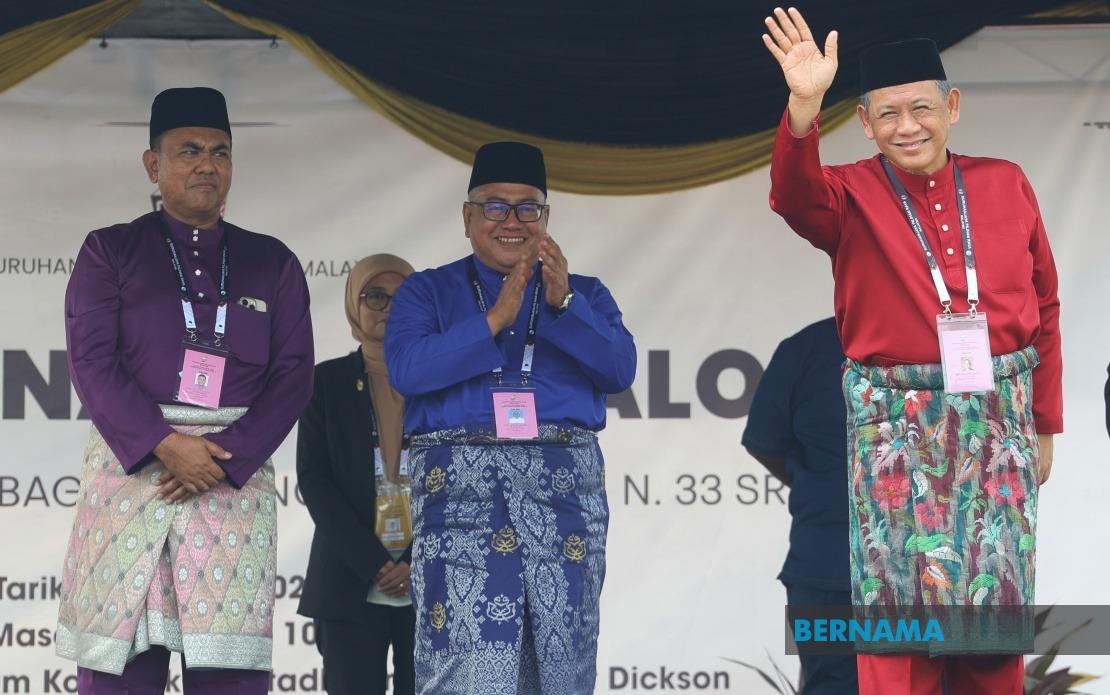
Negeri Sembilan's Menteri Besar Datuk Seri Aminuddin Harun of Pakatan Harapan faces a competitive three-way battle to retain the Linggi seat in the 16th state election, as returning officer Nurhazelin Makli confirmed candidate nominations after the submission deadline on July 18. The Penambang incumbent will square off against two challengers: Datuk Mohd Faizal Ramli, the sitting Barisan Nasional representative, and Bersatu candidate Datuk Zamri Md Said, adding complexity to an election that will determine the political direction of the central state.
The three-cornered contest reflects the fractured opposition landscape in Negeri Sembilan, where the original Barisan coalition has been joined by the splinter Bersatu party in several constituencies. For Aminuddin, who has championed Pakatan Harapan's agenda across the state, the emergence of a third candidate complicates his path to victory even in a seat traditionally considered his stronghold. The Linggi division, which encompasses Port Dickson and surrounding areas, represents a microcosm of Malaysia's shifting political alignments, where consolidation remains elusive despite attempts by various coalitions to build momentum.
Across other constituencies, Pakatan Harapan's state assembly members are similarly navigating competitive multi-cornered contests. In Sri Tanjung, incumbent Dr G. Rajassekaran will defend against Barisan Nasional's A. Achutan and Bersatu's Leevineshwaraan Murugan, a pattern repeated in several other divisions where the opposition vote risk fragmentation. The Lukut seat presents a different dynamic, with Pakatan's Choo Ken Hwa facing Perikatan Nasional's Sathes Kumar Nilameham and independent candidate Teo Seng Lee, underscoring how non-partisan candidates are emerging as wildcards in this election cycle.
Meanwhile, Bagan Pinang offers a particularly interesting contest featuring incumbent PAS representative Abd Fatah Zakaria pitted against Pakatan Harapan's Nasir Raman and Bersatu's Sheikh Junaidy Jamaludin. This configuration highlights the ideological and strategic divisions between Islamist and secular opposition forces in the state, a tension that has defined Malaysian politics since the 2018 general election. The four-way split of anti-establishment votes in such constituencies raises questions about whether opposition consolidation remains possible before polling day.
In contrast, the Chuah seat appears to offer simpler arithmetic, with Pakatan's Yew Boon Lye squaring off directly against Barisan's Pau Jeou Ching in a straight fight. This two-cornered contest may provide clearer voter choice and potentially sharper campaign messaging, unlike constituencies where multiple candidates dilute each party's message. The variation in contest formats across different divisions will likely produce uneven outcomes, rewarding disciplined coalitions while punishing fragmented opposition efforts.
The Election Commission has designated August 1 as the polling day for Negeri Sembilan's state elections, with early voting scheduled for July 28 to accommodate military and police personnel. This compressed timeline means campaigns must accelerate their ground operations immediately following the nomination closure, leaving candidates limited weeks to mobilise voters across their respective divisions. Early voting provisions acknowledge the security forces' deployment requirements, a mechanism that has become standard in Malaysian electoral practice.
According to official figures, 889,490 registered voters in Negeri Sembilan are eligible to cast ballots, comprising 867,151 ordinary voters alongside 16,884 military personnel and their spouses and 5,455 police personnel and their spouses. This electorate size underscores that state-level elections, while administratively smaller than federal contests, still involve substantial populations whose votes will determine which coalition controls the state government. The voter composition also reveals that uniformed services constitute roughly 2.5 percent of the electorate, a meaningful minority in close contests.
For Pakatan Harapan, the Negeri Sembilan election represents a crucial test of its capacity to maintain state government control following its 2018 breakthrough and subsequent challenges. The emergence of Bersatu as a competitor in multiple seats, despite the party having been part of the original Pakatan coalition that won in 2018, reflects the political realignments triggered by Bersatu's departure from the federal coalition and subsequent repositioning. The state serves as a barometer for opposition unity or fragmentation heading into future general election cycles.
Barisan Nasional's challenge involves regaining ground it lost during the 2018 wave while managing its own alliance dynamics with Bersatu in selected constituencies. The strategy of fielding joint opposition candidates against Pakatan targets suggests a pragmatic recognition that split opposition votes benefit neither former coalition partner. However, the competing candidacies in divisions like Linggi indicate that even these tactical arrangements remain imperfect and subject to local pressures and factional considerations.
Bersatu's participation as an independent contestant rather than purely as a satellite of Barisan or Perikatan Nasional signals its determination to establish itself as an autonomous political force in Negeri Sembilan's electoral landscape. The party's insertion of candidates across multiple seats, even against allies, reflects ambitions for ministerial positions and heightened state-level influence following the 2024 federal realignment. This opportunistic positioning ensures that coalition mathematics will dominate campaign narratives throughout the election period.
The Negeri Sembilan election occurs within Malaysia's broader political context of coalition instability and fragmentation that has characterised the post-2022 period. State elections increasingly serve as proving grounds for political parties to test their organisational strength and messaging effectiveness before federal contests. The results here will provide insights into voter preferences regarding coalition building, incumbent performance, and the salience of state-level issues versus national controversies that often dominate campaign discourse.

