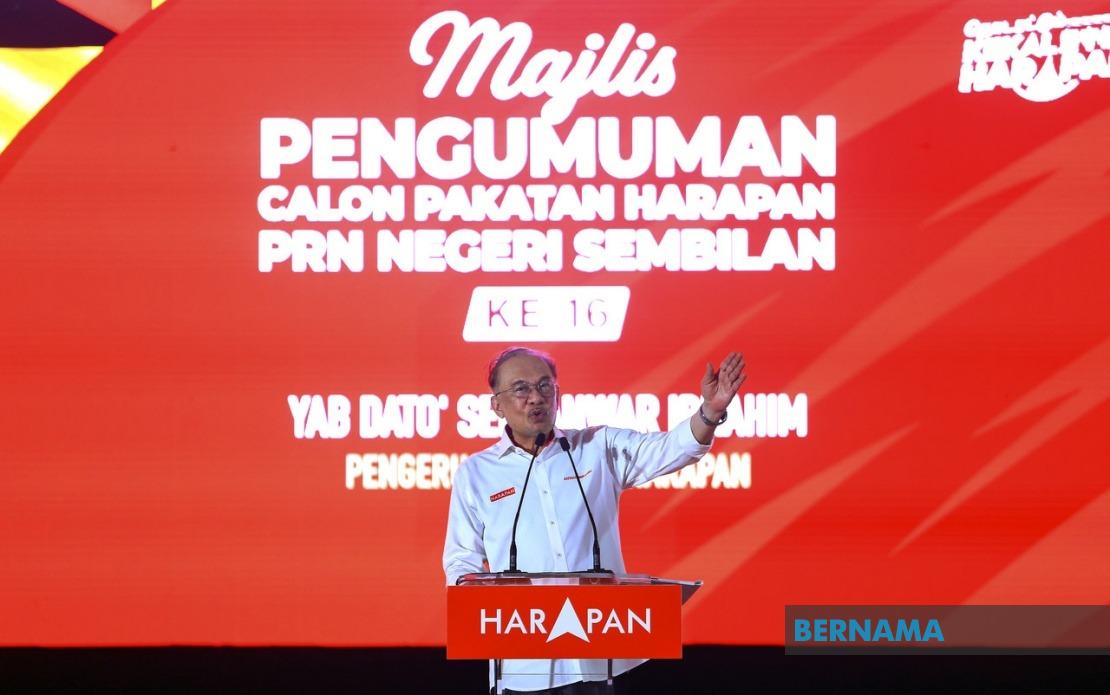
Negeri Sembilan's political landscape is taking shape as Pakatan Harapan unveiled its slate of candidates for the 16th state election, with two heavyweight figures leading the coalition's charge in the central region. Prime Minister Datuk Seri Anwar Ibrahim formally announced the candidacies at a rally in Kuala Pilah on July 14, presenting Menteri Besar Datuk Seri Aminuddin Harun for the Linggi constituency and confirming DAP secretary-general Anthony Loke's bid to retain the Chennah seat. The announcement came before thousands of supporters and senior party officials, underscoring the significance of these nominations for the coalition's electoral fortunes in the state.
Aminuddin's move to contest Linggi marks a shift in his electoral strategy after representing Sikamat for four consecutive terms since 2008. The Negeri Sembilan Menteri Besar and Pakatan Harapan's state chairman has been a cornerstone of the coalition's presence in the state, with his consistent electoral victories reflecting strong grassroots support. His transition to the Linggi seat suggests internal strategic calculations within Pakatan Harapan regarding seat allocation and resource deployment across Negeri Sembilan's 36 state constituencies. The decision carries implications for Sikamat, which has benefited from Aminuddin's direct attention and considerable ministerial resources during his tenure.
Loke's continued representation of Chennah represents continuity in the coalition's strategy, with the seasoned DAP parliamentarian seeking to extend his tenure in a seat he has held since 2013. As DAP secretary-general, Loke's position bridges federal and state politics, making his Chennah victory strategically important for the party's regional influence. His incumbent status provides electoral advantages, though opposition parties will undoubtedly target the seat aggressively. The retention of Loke in Chennah signals Pakatan Harapan's confidence in his electoral machinery and his ability to withstand sustained challenges from rival coalitions.
The candidate announcements reflect broader dynamics within Pakatan Harapan's coalition management. The presence of Amanah president Datuk Seri Mohamad Sabu, communications director Datuk Seri Fahmi Fadzil, and election director Datuk Seri Amirudin Shari at the ceremony underscored the high-level coordination required for state-level campaigning. These individuals represent different components of the coalition—Amanah, PKR, and presumably DAP—and their collective involvement suggests consensus around the nominee selections. For Malaysian observers, coalition unity remains critical in an increasingly fragmented political environment, particularly in states where opposition forces have demonstrated capacity to challenge ruling coalitions.
Negeri Sembilan's electoral significance extends beyond the state's nine parliamentary seats. The state has historically served as a barometer for peninsular political sentiment, with results often foreshadowing national trends. Aminuddin's leadership as Menteri Besar positions the Linggi contest as a referendum on the coalition's governance record in Negeri Sembilan. Voters in the state have experienced Pakatan Harapan's stewardship directly, and their verdict will carry weight in assessments of the coalition's viability heading toward the next general election.
The Linggi and Chennah contests will unfold amid broader regional political turbulence. Neighbouring Selangor and Melaka, together with Negeri Sembilan, comprise the central economic heartland of Peninsular Malaysia. Electoral outcomes in these states influence investment confidence, development trajectories, and intra-coalition dynamics within Pakatan Harapan itself. A strong showing in Negeri Sembilan would consolidate Pakatan Harapan's control over this economically vital region, while poor performance might emboldened opposition efforts in adjacent states.
Aminuddin's Sikamat legacy presents an interesting case study for succession planning in Malaysian state politics. His four consecutive electoral victories suggest robust personal political machinery and community entrenchment. Transferring his candidacy to Linggi requires deploying that machinery to an unfamiliar constituency where ground support may be less established. The decision reflects confidence in his personal appeal transcending seat-specific factors, though opposition strategists will likely attempt to frame the move as abandonment of Sikamat residents after four terms of representation.
Loke's stability in Chennah contrasts with the broader volatility characterising Malaysian electoral politics. His decade-long presence in the seat provides institutional knowledge, constituent relationships, and established campaign infrastructure. For DAP, which has struggled in recent electoral cycles to maintain its parliamentary presence, Loke's successful defence of a state seat contributes to the party's overall resilience narrative. His performance will be scrutinised within the DAP's own internal leadership calculations, given his elevated position as secretary-general.
The July 14 announcement represents an early stage in what will likely be an intense campaign period. Negeri Sembilan voters will be approached by representatives from Pakatan Harapan, Perikatan Nasional, and potentially independent candidates. The state's 36 constituencies will witness vigorous competition, with incumbent advantages competing against anti-incumbency sentiments and broader economic concerns. For regional observers monitoring Malaysian politics, the Negeri Sembilan election will provide crucial data on voter sentiment regarding governance performance, coalition stability, and appetite for political change.

