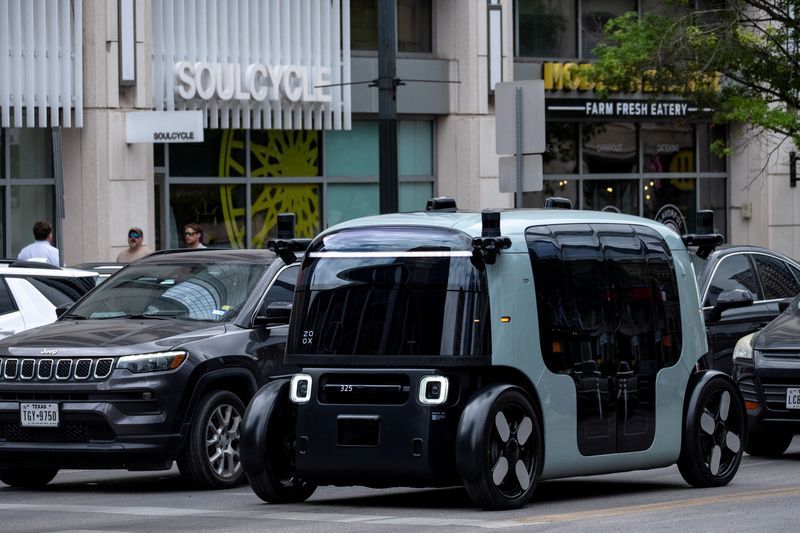
Amazon's autonomous vehicle subsidiary Zoox is stepping into the commercial robotaxi arena this week, beginning paid passenger services in Las Vegas after securing federal regulatory clearance. The milestone arrival of paying customers represents a significant moment for the autonomous ride-hailing sector, which has evolved from years of testing to genuine market competition as multiple technology giants race to establish their presence in this emerging transportation category.
Zoox's decision to launch paid operations in the Nevada capital comes immediately after receiving approval from the National Highway Traffic Safety Administration to deploy its purpose-built vehicles without human safety drivers. The company's distinctive electric carriages feature two rows of seats positioned to face inward, a design that reflects its ground-up engineering rather than modifications to conventional vehicles. This approval places Zoox in an exclusive category among robotaxi developers, distinguishing it from competitors who have adapted existing automobile platforms for autonomous operations.
The regulatory green light carries specific constraints that will govern Zoox's expansion strategy. NHTSA has granted permission to deploy up to 2,500 vehicles annually across the next two years, establishing a measured pathway for growth rather than unlimited expansion. The agency determined that Zoox's vehicle meets safety standards equivalent to conventional vehicles with human drivers, though regulators have imposed additional reporting requirements for incidents including crashes, safety malfunctions, and inappropriate roadway stoppages. This balanced approach reflects ongoing tensions between supporting innovation and maintaining public safety oversight in an industry still establishing operational norms.
Zoox will price its Las Vegas service at a level comparable to the premium "comfort" tier offered by established ride-hailing platforms, typically commanding fares between 20 and 40 percent above standard service rates. The company will employ a transparent pricing model based on base fares supplemented by time and distance calculations, with special fees—particularly for airport services—disclosed at the point of booking. Notably, Zoox guarantees that customers will not face unexpected charges if the autonomous system selects a route longer than anticipated, addressing a consumer concern that has occasionally plagued conventional ride-hailing services where routing algorithms and driver behaviour can diverge.
The commercial launch intensifies an already competitive robotaxi landscape where multiple actors are vying for market position and operational data. Alphabet's Waymo has already established paid driverless services across several cities, accumulating extensive real-world experience and building customer familiarity with the concept. Tesla has begun rolling out its own autonomous ride-hailing capabilities, leveraging its enormous installed base of vehicles equipped with autonomous driving hardware. These competing services represent different technological philosophies and business models, creating a genuine test of which approaches will ultimately prove scalable and profitable at commercial volumes.
For Asian technology and automotive observers, Zoox's advancement carries implications extending beyond the United States market. The regulatory framework emerging through NHTSA's decisions may influence how other nations approach robotaxi governance. The approval process reveals how governments can balance innovation encouragement with safety requirements, a framework potentially instructive for policymakers in Malaysia, Singapore, and other Southeast Asian economies considering autonomous vehicle policies. Additionally, the success or struggles of these American operations will provide crucial data about consumer adoption patterns, operational challenges, and economic viability that Asian markets will monitor closely.
Yet significant safety questions remain unresolved for the entire sector. Zoox and its competitors continue facing intense regulatory scrutiny regarding emergency response capabilities and interactions with other road users—areas where autonomous systems have demonstrated vulnerabilities. The company issued a notable software recall in July when one of its vehicles failed to adequately detect heavy smoke at an emergency scene, highlighting gaps in sensory interpretation and threat assessment. Such incidents underscore that extensive real-world testing has not eliminated all failure modes, and regulators must balance commercial momentum against documented safety concerns.
Zoox has issued multiple software recalls over recent years, demonstrating that the journey from testing to reliable commercial operations involves ongoing refinement and problem-solving. Each recall represents a moment where the autonomous system's limitations became evident, triggering corrective action. While this iterative improvement process resembles development patterns in other complex technologies, the public safety implications of autonomous vehicles operating in urban environments demand extraordinarily high reliability standards that exceed those accepted in many other industries.
The company has not yet disclosed timelines for expanding paid services to other cities where it currently operates free trials—San Francisco, Austin, and Miami. This measured approach suggests that Zoox is prioritising operational stability and learning from Las Vegas deployment before dispersing management attention across multiple commercial markets. The sequential launch strategy provides a template for other autonomous vehicle operators who must balance investor expectations for rapid growth against the genuine operational and safety complexities of scaling novel transportation systems.
As robotaxi operators begin capturing paying customers, the broader transportation ecosystem faces uncertainties. Traditional taxi operators and conventional ride-hailing platforms like Uber and Grab are watching these autonomous deployments carefully, understanding that successful robotaxi scaling could reshape urban mobility markets. The economic model remains partially unproven—whether autonomous vehicles can generate sufficient volume and margin to justify their development costs remains an open question that commercial operations will begin answering.

