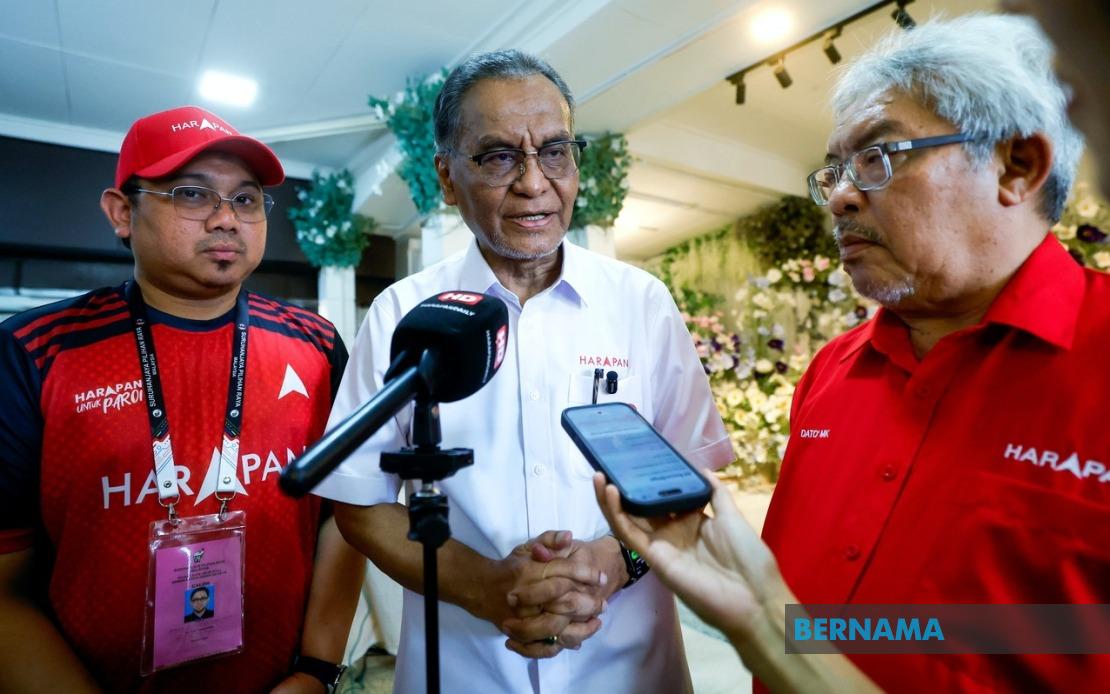
The campaign machinery for Pakatan Harapan in Negeri Sembilan is shifting focus away from bombastic rhetoric, instead positioning its nine Parti Amanah Negara candidates as practitioners of results-driven governance. Speaking in Seremban, Amanah vice-president Datuk Seri Dr Dzulkefly Ahmad articulated a deliberate electoral strategy grounded in demonstrating what the state government has accomplished since taking office, coupled with candidates who possess verifiable credentials of community service.
This positioning reflects a calculated acknowledgment that Malaysian voters increasingly evaluate coalitions not on promises alone but on tangible delivery. The coalition's seat arrangement—with Amanah contesting nine of the 36 seats Pakatan Harapan is defending, while Parti Keadilan Rakyat contests 16 and the Democratic Action Party 11—signals internal coordination aimed at maximising the government's re-election prospects. The allocation mirrors the component parties' existing representation and maintains unity ahead of what could be a closely contested election.
For Negeri Sembilan specifically, the messaging carries particular weight. The state was an early battleground where Pakatan Harapan demonstrated electoral viability outside its traditional urban strongholds. In the 2023 state election, the coalition secured 17 of 36 seats, establishing a working majority against Barisan Nasional's 14 seats and Perikatan Nasional's five. That outcome positioned Negeri Sembilan as proof of concept that the coalition could govern in relatively conservative constituencies, a narrative Amanah intends to reinforce by highlighting administrative continuity and problem-solving capability.
Dr Dzulkefly's emphasis on "track record, ability to solve problems and commitment to serving the people" rather than campaign volume represents a implicit criticism of opposition campaigning styles. The approach suggests Amanah believes voters in Negeri Sembilan are fatigued by rhetorical excess and responsive to evidence of governance effectiveness. Each of the nine candidates brings prior experience in public service or grassroots engagement—a deliberate curation designed to project competence rather than political newcomer status.
The Paroi constituency exemplifies this strategy in microcosm. With over 65,000 registered voters and a population nearing 140,000, the seat encompasses diverse economic interests requiring coordinated problem-solving across multiple government agencies. The incumbent candidate Ahmad Shahir Mohd Shah's emphasis on empowering small traders—through streamlined licensing, amenity provision, and business district upgrades in partnership with local authorities—demonstrates how Amanah is translating governance priorities into constituency-specific pledges. This granular focus on business facilitation reflects recognition that economic concerns, particularly among the self-employed and informal sector, substantially influence electoral behaviour in semi-urban Negeri Sembilan constituencies.
Amanah's broader campaign architecture incorporates layered engagement tactics designed to convert face-to-face interaction into sustained political commitment. House-to-house visits and small-group discussions create opportunities for candidates to identify constituent grievances before routing them through institutional channels for resolution. Social media amplification extends reach beyond physical campaigning, enabling candidates to maintain constituency presence and demonstrate responsiveness asynchronously. This multi-channel approach acknowledges that contemporary electoral competition occurs simultaneously in physical and digital spaces, and effective candidates must maintain coherent messaging across both.
The slate of eight other Amanah candidates—including incumbent Datuk Bakri Sawir defending Klawang, alongside Yaacob Mahmood in Serting, Zarrina Abu Zarin in Lenggeng, Mohd Hanis Alimin in Senaling, Mohd Zailan Mohd Munawar in Johol, Muhammad Allif Ibrahim in Kota, Nasir Raman in Bagan Pinang, and Abd Latif A. Tambi in Gemencheh—spreads the party's competitive effort across constituencies of varying demographic and economic profiles. This geographic spread ensures that Amanah maintains presence in both urban-fringe and more rural constituencies, preventing concentration of party resources in easily-won areas.
For Malaysian readers and regional observers, Negeri Sembilan's forthcoming election on August 1 carries significance beyond a single state's administrative mandate. The result will indicate whether voters perceive Pakatan Harapan's governance model as sufficiently competent to reward continuation, or whether economic pressures and other dissatisfactions have eroded the coalition's 2023 momentum. Amanah's strategic choice to emphasise service and track record rather than opposition critiques suggests internal coalition confidence that its record will survive scrutiny.
The timeline—with early voting scheduled for July 28—provides compressed campaigning window requiring maximum efficiency from the coalition's ground operations. In this constrained timeframe, Amanah's strategy of converting candidate credentials into voter confidence becomes crucial. Parties with shallow grassroots penetration struggle to mobilise constituencies effectively when campaign periods compress; established networks and prior community relationships become campaign force multipliers.
Negeri Sembilan's electoral outcome will also provide data regarding Pakatan Harapan's durability in middle-income suburban constituencies that lack the urban progressivism of Kuala Lumpur or Penang but possess populations increasingly evaluative of governance quality. Should the coalition sustain its 2023 performance or improve, it will demonstrate that service-oriented campaigns resonate with such electorates. Conversely, losses would suggest that governance narratives alone insufficient to maintain electoral majorities against opposition mobilisation or internal coalition friction. For Amanah specifically, the nine contested seats represent both opportunity and vulnerability—strong performances would validate the party's positioning as competent administrator within Pakatan Harapan, while underperformance could invite questions about whether the party's strategic emphasis on service-based messaging aligns with voter priorities in competitive constituencies.

