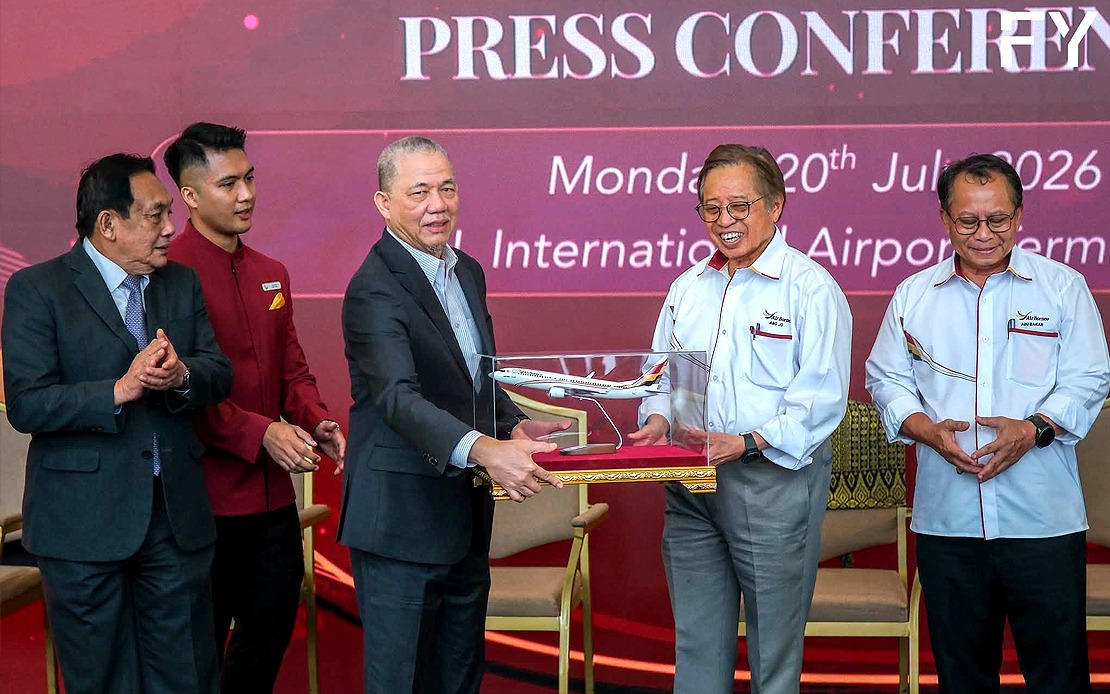
The long-awaited inaugural flight of AirBorneo Airways touched down at Kuala Lumpur International Airport on July 20, marking a watershed moment for Sarawak's aviation sector and a direct attempt to resolve a perennial grievance that has plagued the state for years. Deputy Prime Minister Datuk Seri Fadillah Yusof framed the carrier's launch not merely as a commercial venture but as a strategic instrument designed to reshape air connectivity across one of Malaysia's largest states, arriving at a particularly symbolic moment just two days before Sarawak Day celebrations on July 22.
The establishment of AirBorneo represents a fundamental shift in how Sarawak approaches its transportation challenges. Controlled entirely by the state government, the airline embodies a conviction that local ownership of critical infrastructure can yield better outcomes for residents than reliance on private carriers operating primarily along profitable routes. Fadillah articulated a vision extending far beyond simply matching rival carriers' prices, emphasising instead a commitment to delivering services that prioritise affordability, pricing transparency, and passenger convenience whilst maintaining acceptable quality standards—a balance that has proven elusive under existing arrangements.
Sarawak's historical struggle with aviation costs reflects its geographic realities. As a vast state with dispersed population centres and limited terrestrial transport networks, air travel remains essential for both residents and economic development. Previous complaints centred on ticket prices that seemed disproportionate to distance flown, perceived service inconsistencies, and inadequate connections to smaller towns where commercial viability concerns had deterred existing operators. These grievances accumulated into a political liability that successive administrations felt compelled to address.
Premier Tan Sri Abang Johari Tun Openg has characterised AirBorneo as far more than a simple cost-reduction mechanism. According to official framing, the carrier functions as a strategic economic catalyst designed to unlock opportunities across multiple sectors—particularly tourism, where improved and affordable connectivity could significantly boost visitor numbers; regional trade, where reliable air freight services matter enormously; and investment attraction, where transportation infrastructure directly influences business location decisions. This multisectoral perspective suggests policymakers view aviation not as an isolated service but as foundational to broader economic transformation.
The airline's particular emphasis on rural connectivity addresses a chronic market failure. Private carriers typically avoid routes with lower passenger density, meaning remote communities face either prohibitively expensive flights or no regular service whatsoever. By incorporating service obligations to underserved areas as part of its operational mandate, AirBorneo fills a gap that commercial actors systematically neglect. This public service dimension distinguishes state ownership from purely profit-driven models and potentially justifies sustained government investment even if certain routes generate losses.
Fadillah's remarks underscored AirBorneo's symbolic importance to Sarawak's political autonomy narrative. The airline represents tangible evidence of the state's capacity to undertake substantial infrastructure projects independently, reinforcing arguments about Sarawak's economic maturity and developmental aspirations. By controlling its own air transport network, the state gains leverage over a sector that had previously been determined by external commercial operators' strategic decisions, a consideration with profound implications for long-term planning and competitive positioning within Malaysia's regional economy.
The timing of the inaugural service—mere days before Sarawak Day—invoked historical resonances about the state's development trajectory and its relationship to federal structures. Launching new transportation infrastructure on this culturally significant date suggested that aviation advancement represented continuity with Sarawak's modernisation agenda rather than departure from traditional governance patterns. This symbolic framing proved important for legitimising what remains a substantial public financial commitment during a period of broader fiscal constraints.
For Malaysian air travellers more broadly, AirBorneo's emergence introduces a new competitive dynamic on domestic routes previously serviced primarily by established carriers. On the critical Kuching-KLIA corridor, the inaugural flight signals an intention to challenge existing fare levels and service assumptions. If AirBorneo sustains operations profitably while maintaining lower prices, it could exert downward pressure on competitors' pricing—an outcome particularly beneficial to Sarawakians making regular business and family trips to peninsular Malaysia.
However, the airline's long-term viability remains contingent on factors beyond pricing strategy alone. Fuel costs, aircraft maintenance expenses, airport fees, and labour expenses represent major cost drivers over which a regional carrier wields limited influence. Sustaining genuinely affordable fares whilst meeting these obligations requires either exceptionally efficient operations, consistent government subsidies, or some combination thereof. The political commitment demonstrated by today's launch does not automatically guarantee the financial structures needed to support operations indefinitely.
AirBorneo's entrance also occurs within a broader Asian aviation context characterised by intense competition from both legacy carriers and low-cost operators. Maintaining differentiation whilst serving a state-specific mandate presents strategic complexity. Success requires cultivating sufficient passenger volume on commercially viable routes to cross-subsidise service to less profitable communities—a delicate equilibrium complicated by seasonal tourism fluctuations and economic cycles affecting business travel demand.
Regional observers will scrutinise whether AirBorneo can translate political commitment into sustained operational success. The initiative demonstrates Sarawak's determination to address transportation challenges through state capacity-building rather than accepting private sector constraints. If the airline achieves its dual objectives of affordability and acceptable profitability, it could establish a precedent influencing other Malaysian states' infrastructure strategies. Conversely, should operations encounter difficulties, the experience could inform broader debates about state enterprises' appropriate role in competitive commercial sectors.
The immediate challenge involves establishing consistent, reliable service whilst building passenger confidence in a newcomer competing against well-established carriers. Success on the Kuching-KLIA route will likely determine whether AirBorneo can sustain expansion toward secondary cities and rural markets where its social mission objectives concentrate. Fadillah's aspiration for affordable, transparent, and passenger-centric aviation reflects genuine needs; translating that vision into operational reality represents the genuine test ahead.

