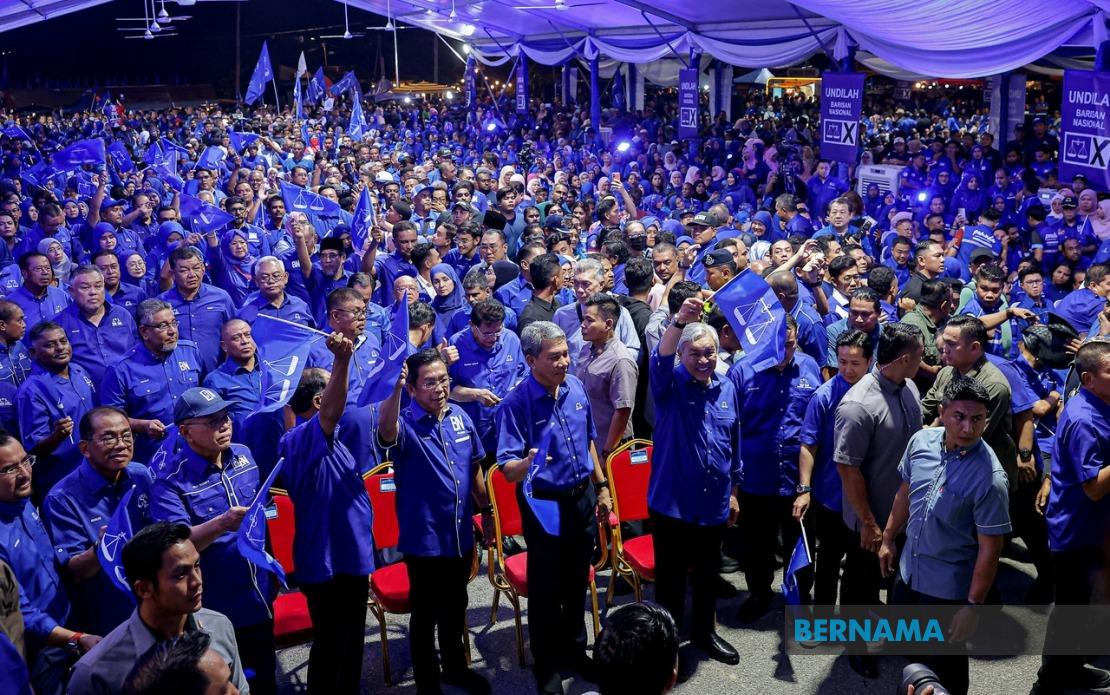
Barisan Nasional must translate its extraordinary Johor state election triumph into a decisive victory in Negeri Sembilan, according to BN chairman Datuk Seri Dr Ahmad Zahid Hamidi, who launched the coalition's campaign machinery and announced its candidates at Tuanku Abdul Rahman Stadium in Paroi on July 15. The UMNO president seized on the party's historic showing in the neighbouring state as proof that voters reward BN with power when leadership demonstrates stability, economic competence, and responsible governance—a template he contends applies equally to the upcoming 16th Negeri Sembilan state election set for August 1.
The Johor result provided Ahmad Zahid with powerful ammunition for his call to party members to intensify ground-level canvassing across Negeri Sembilan constituencies. BN's capture of 48 of 56 state seats in Johor, combined with nearly 60 per cent of the popular vote, represented the coalition's largest margin of victory in that state's electoral history. By invoking these numbers during the candidate launch, Ahmad Zahid sought to energize activists and dispel any lingering doubts about BN's electoral viability following years of political turbulence and internal discord that had eroded voter confidence in the coalition during the 2018-2022 period.
The machinery activation represents a critical strategic phase as the Election Commission has compressed the campaign calendar considerably. Nomination day fell on July 19, with early voting scheduled for July 28 and polling day fixed for August 1, leaving parties minimal time to consolidate messaging and mobilize volunteers. The compressed timeline adds urgency to Ahmad Zahid's exhortations for members to begin door-to-door engagement immediately, prioritizing broad voter contact over protracted internal deliberation about candidacy distribution among the coalition's multiple parties.
Ahmad Zahid articulated a particular concern about intra-party friction derailing BN's Negeri Sembilan ambitions. He explicitly cautioned members against becoming preoccupied with candidate selection processes and factional considerations at the expense of the coalition's overarching electoral objective. This warning reflects awareness that Negeri Sembilan, despite BN's 14-seat showing in the 2023 state election, remains a battleground where marginal shifts in voter behaviour could produce significantly different outcomes. The previous election result demonstrated BN's capacity to govern the state, yet also illustrated the coalition's vulnerability to erosion of support if internal management falters during campaigns.
The deputy prime minister stressed that BN's Johor success stemmed fundamentally from coalition unity and coordinated effort among member parties. He characterized the winning formula as dependent on BN components setting aside differences, managing grievances internally, and projecting a unified public front. This emphasis on collective identity rather than individual party branding suggests Ahmad Zahid views BN's electoral trajectory as intrinsically linked to institutional cohesion. For Malaysian readers following coalition politics, this articulation matters because BN's durability as a governing force depends precisely on such unity mechanisms functioning effectively, particularly given the diverse ethnic, religious, and regional constituencies represented within the coalition structure.
The Negeri Sembilan election carries broader significance for BN's national standing and internal dynamics. Negeri Sembilan occupies a historically important position within Peninsular Malaysia's political geography, and a strong BN performance would reinforce the narrative that the coalition has successfully arrested the decline in voter support that culminated in the 2018 general election result. Conversely, underperformance would complicate Ahmad Zahid's positioning within UMNO and raise questions about BN's capacity to sustain momentum beyond individual state contests toward credible preparations for the next general election, widely anticipated around 2025.
Ahmad Zahid's confidence in improving upon the 2023 result reflects quantifiable grounds for optimism regarding vote share and seat capture, though state-level contests often turn on localized factors and community-specific concerns that national narratives do not fully capture. The presence of BN deputy chairman Datuk Seri Mohamad Hasan and other coalition leaders at the stadium event underscored institutional commitment to the campaign, with the formal machinery activation representing the point at which professional organization and volunteer enthusiasm converge ahead of intensive canvassing.
The timing of the Negeri Sembilan election immediately following the successful Johor campaign creates either an opportunity or a vulnerability for BN, depending on strategic execution. Electoral momentum can be real and measurable in voter responsiveness, yet it dissipates quickly if parties fail to capitalize through sustained fieldwork. Ahmad Zahid's emphasis on eliminating distraction—whether through personal disappointment over candidate selection or residual factional tensions—directly addresses the mechanism through which momentum gains can be squandered. For regional observers tracking Southeast Asian coalition politics, BN's ability to manage such organizational discipline while fighting competitive elections offers instructive lessons about sustaining multiparty arrangements in pluralistic systems.
The Deputy Prime Minister's framing of the contest also reflects sensitivity to narratives about BN's governance credentials and capacity for responsible administration. By contrasting BN's approach with implied alternatives, Ahmad Zahid positioned the election as fundamentally a choice between experienced, stable administration and unproven alternatives. This argument resonates particularly in Negeri Sembilan given the state's relatively stable governance history and middle-class voter base that typically prioritizes economic management and administrative efficiency over ideological positioning.
Looking forward, the Negeri Sembilan result will function as a bellwether for BN's broader electoral prospects and internal health as the coalition approaches the next general election cycle. A decisive victory would validate the unity messaging and suggest that BN's revival narrative has taken hold with voters beyond Johor. A narrower margin or unexpected setback would signal that the Johor result may reflect state-specific circumstances rather than a durable realignment of voter preferences toward the coalition. For Malaysia's political ecosystem, the stakes extend beyond Negeri Sembilan to encompass questions about whether BN can establish itself as a credible governing alternative with consistent appeal across different state electorates and demographic groups.

