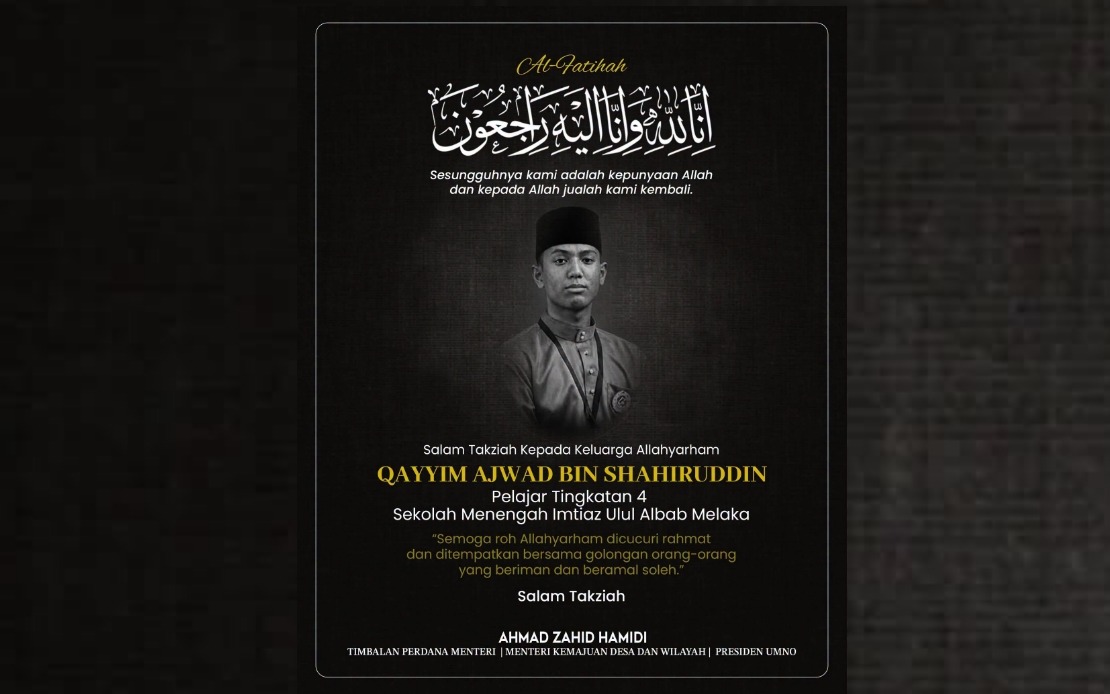
Deputy Prime Minister Datuk Seri Dr Ahmad Zahid Hamidi has expressed heartfelt condolences following the death of Qayyim Ajwad Shahiruddin, a student from Sekolah Menengah Imtiaz Ulul Albab in Melaka, who passed away from injuries incurred in a road accident that occurred earlier this month. The student's death marks a tragic conclusion to an incident that has left ripples across the school community and beyond, prompting the nation's second-highest ranking official to publicly acknowledge the loss through a detailed Facebook statement.
The fatal accident occurred on July 8 in Solok Duku, Melaka, involving a collision between a school vehicle and a lorry. The incident transpired while Qayyim Ajwad and his companions, including a teacher and two other students, were returning from a table tennis competition held at Sekolah Jenis Kebangsaan Cina Cheng. The accident left multiple casualties receiving medical treatment, with Qayyim Ajwad's condition remaining critical before ultimately proving fatal.
In his public statement, Ahmad Zahid characterised the student's passing as an overwhelming loss, emphasising the personal nature of his connection to the educational institution. His words reflected a pattern of close engagement with the school, which he framed through familial language, suggesting a bond that transcends typical political acknowledgment. The Deputy Prime Minister's intervention signals the prominence of the school within his political constituency and the significance he places on youth welfare matters.
Ahmad Zahid extended his prayers for the recovery of the remaining accident victims who continue to receive medical care for their sustained injuries. His religious invocation, delivered in formal Islamic terminology, demonstrated respect for the gravity of the situation and aligned with customary Malaysian responses to tragedy. The gesture underscored the emotional toll the incident has exacted on multiple families affected by the accident.
The Deputy Prime Minister's statement emphasised collective spiritual support for the deceased student's family during their bereavement period. He called upon Malaysians to recite al-Fatihah, the opening chapter of the Quran, as a traditional expression of condolence and spiritual solidarity within Islamic practice. This appeal to broader national participation in mourning rituals reflected cultural sensitivity and inclusive grief management within a multi-religious society.
The incident highlights recurring concerns regarding road safety in Malaysia, particularly involving school vehicles transporting students to and from sporting and educational activities. While such competitions serve important developmental purposes, they simultaneously expose young people to transport-related hazards on Malaysian roadways. The accident on July 8 represents one of several incidents that have prompted ongoing debates about vehicle maintenance standards, driver training requirements, and route safety protocols for school-organised excursions.
The specific circumstances of the collision between the school vehicle and a lorry remain subject to investigation, though preliminary reports suggest multiple occupants were affected. The involvement of a teacher alongside students in the accident adds another dimension to the tragedy, extending concern across both the educator and student populations of the institution. Such incidents invariably prompt institutional reviews of safety procedures and operational protocols.
SM Imtiaz Ulul Albab has maintained a distinct position within Melaka's educational landscape, and the accident represents a significant disruption to the school community. The institution's reputation and pastoral care capacity will likely be tested as administrators navigate the immediate aftermath of the tragedy and support grieving students, staff, and families. The broader school network across Malaysia often experiences shared shock following student fatalities, fostering collective reflection on safety culture.
Ahmad Zahid's public engagement with this incident reflects broader expectations placed upon senior government officials to demonstrate empathy during national crises and personal tragedies affecting constituents. His intervention, delivered through social media platforms, exemplifies contemporary political communication patterns where ministers and senior leaders acknowledge significant community events through digital channels. Such statements serve multiple functions simultaneously: expressing genuine condolences, acknowledging institutional connections, and maintaining public visibility during moments of heightened emotional resonance.
The death of Qayyim Ajwad Shahiruddin represents a sobering reminder of the vulnerabilities inherent in arranging youth activities beyond school premises, regardless of legitimate educational objectives. The incident underscores persistent challenges within Malaysia's road safety framework, suggesting that even carefully planned and supervised student outings remain susceptible to tragic accidents. Moving forward, educational institutions and transport providers may face increased scrutiny regarding safety measures, vehicle conditions, and route planning procedures.
The family's grief, acknowledged through Ahmad Zahid's formal statement, carries broader implications for institutional accountability and community safety discourse. While the Deputy Prime Minister's words provided immediate and heartfelt recognition of the tragedy, the longer-term response will involve technical investigations, institutional reviews, and potentially systemic reforms addressing vehicle safety standards and transportation protocols for school-organised activities across Malaysia.

