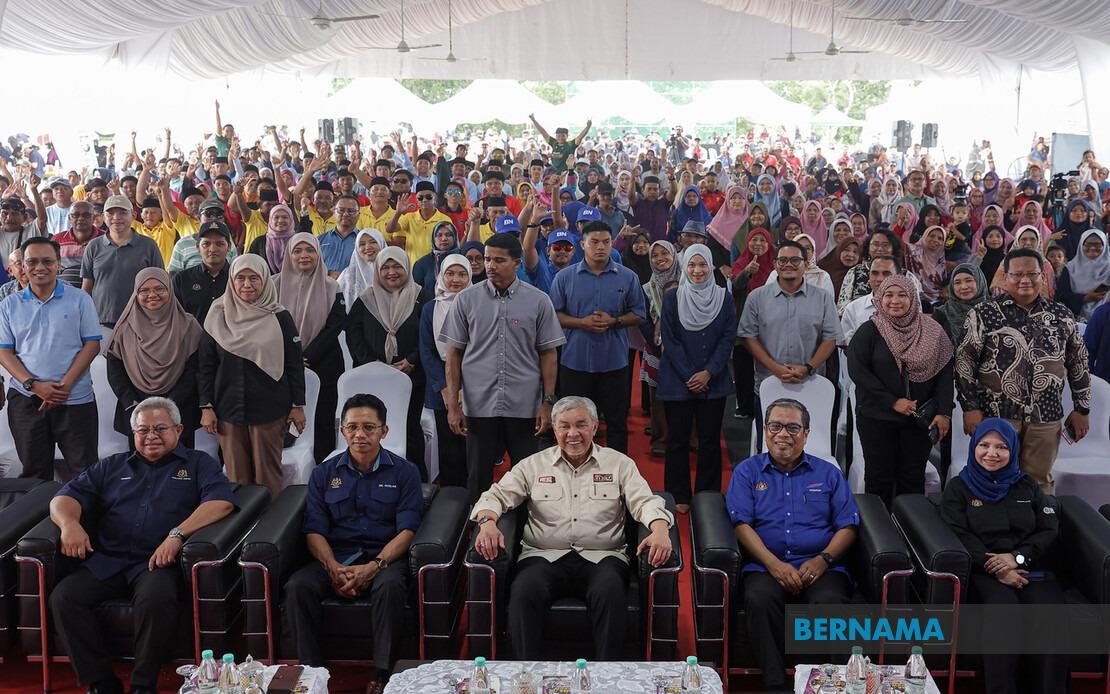
Malaysia's political landscape has grown too fluid for conventional approaches, according to Barisan Nasional (BN) chairman Datuk Seri Dr Ahmad Zahid Hamidi, who on July 18 called for fresh strategic thinking and coalition arrangements among competing political forces. Speaking in Jempol during the Gema@KKDW 2026 programme at Palong 8, Ahmad Zahid acknowledged that the nation's politics has entered a phase requiring coalition partners to adapt quickly and collaborate in innovative ways to prevent instability and maintain governance effectiveness.
The BN leader cited the emerging understanding between Barisan Nasional and Perikatan Nasional (PN) regarding the forthcoming 16th Negeri Sembilan state election as a potential blueprint for future cooperation. Rather than framing this as a permanent merger or rigid alliance, Ahmad Zahid presented it as a pragmatic arrangement designed to test whether two major coalition blocs can work together harmoniously without sacrificing their individual political identities. He signalled that depending on how this partnership performs in the Negeri Sembilan contest, Malaysian political leadership will reassess whether similar frameworks should be extended to the upcoming Melaka state election and ultimately to the next General Election (GE16).
Crucially, Ahmad Zahid emphasised that the BN-PN understanding does not constitute a formal political union with binding legal obligations. Instead, the arrangement centres on a straightforward principle: preventing duplicate candidacies in contested constituencies that would fragment voter support and weaken overall electoral outcomes. This distinction is significant for Malaysian politics, where coalitions have traditionally involved comprehensive power-sharing agreements and joint manifestos. The looser structure allows both BN and PN to maintain their separate organisations, internal hierarchies, and future strategic independence while collaborating tactically where their interests align.
The rationale underlying this approach reflects demographic and electoral realities across Malaysian states. When multiple parties contest the same seat, vote-splitting can hand victory to an opponent neither coalition supports, a dynamic that has repeatedly shaped state and federal election results. By negotiating seat allocations beforehand, BN and PN aim to consolidate their combined voter bases and maximise their collective parliamentary representation. However, this logic also implies that such arrangements remain conditional and transactional rather than ideologically or structurally integrated.
For Malaysian observers, the Negeri Sembilan state election scheduled for August 1, with early voting on July 28, represents a genuine stress test of cross-coalition cooperation. The state, historically a BN stronghold, will demonstrate whether senior leaderships from rival coalitions can enforce discipline among grassroots members who may harbour deep competitive instincts. Any significant friction, public disagreements over seat distributions, or contested nominations could undermine confidence in scaling this model upward to larger contests affecting federal governance.
The timing of Ahmad Zahid's statements also merits attention within the context of Malaysia's 10-year political cycle. General Election 16 remains at least two years away, allowing current coalitions time to experiment with various arrangements and gauge their effectiveness. However, state elections occurring before GE16 provide natural laboratories for testing cooperation models, refinement of messaging, and identification of logistical challenges. Perak, Selangor, and Penang all face state polls before the federal election, offering additional opportunities to evaluate whether BN-PN arrangements can deliver promised benefits.
From a Malaysian voter perspective, these machinations reflect both sophisticated political realism and underlying fragmentation. The nation's electorate has diversified its choices significantly since 2018, when Pakatan Harapan first breached BN's federal monopoly. Rather than consolidation around two clear alternatives, Malaysian voters now distribute preferences across multiple coalitions and independent politicians. This fragmentation incentivises exactly the kind of fluid, issue-specific cooperation Ahmad Zahid describes. Political leaders pragmatically recognise that rigid, unchanging alliances may not match evolving voter preferences and demographic shifts.
The regional implications of Malaysia's political realignment should not be understated. Southeast Asia's largest federal democracy serves as a barometer for multiethnic governance stability throughout the region. Coalition instability or persistent vote-splitting that produces fractious parliaments can ripple across borders, affecting investor confidence, foreign policy coherence, and regional standing. Conversely, Malaysian political blocs that develop mature mechanisms for managing competition while preventing paralysis offer valuable lessons for neighbouring democracies navigating their own transitions.
Looking ahead, Ahmad Zahid's emphasis on flexibility and testing suggests that Malaysian political strategy will increasingly resemble competitive sports rather than traditional ideological struggle. Different coalitions will assemble, perform in specific contests, evaluate outcomes, disassemble, and reconfigure based on performance data and evolving circumstances. This approach prioritises electoral victory and governance formation over consistent principle or permanent partnership commitments. Whether such transactional politics ultimately strengthens or weakens Malaysia's democratic institutions remains an open question, but for now, senior leaders appear convinced that adaptation and pragmatism outweigh loyalty and consistency as foundations for political survival.

