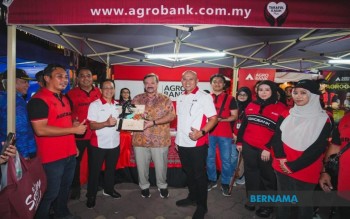
Agrobank has mobilized over RM8 million in financing applications by taking its outreach directly to traders and micro-entrepreneurs at grassroots markets across Malaysia, signalling strong demand for accessible small business capital in underserved communities. The bank's strategy of conducting on-the-ground engagement sessions has proven particularly effective in generating interest among hawkers who traditionally face barriers to conventional financing. Recognizing the success of these initiatives, Agrobank has now expanded its efforts beyond the Klang Valley into Sabah, conducting sessions at the Api-Api Night Market on Jalan Gaya in Kota Kinabalu and the Papar Tamu Farmers' Market, bringing the bank's support infrastructure to East Malaysia's trading communities.
The expansion into Sabah represents a deliberate effort to extend financial services to regions beyond major urban hubs where small traders often operate with limited access to formal banking channels. These engagement sessions have been deliberately designed to address the immediate needs of working capital financing and business expansion support, the two primary constraints cited by hawkers and micro-entrepreneurs across Malaysia. By conducting these sessions at established trading venues rather than requiring traders to visit bank branches, Agrobank has removed a significant friction point in the application process, enabling rapid mobilization of capital applications.
At the Api-Api Night Market engagement session, Agrobank's team interacted with 153 separate hawkers and entrepreneurs, while the Papar session attracted 95 traders. These numbers underscore the receptivity of Sabah's informal economy to formalized financing options when presented accessibly. The choice of night markets and farmers' markets as engagement venues reflects a sophisticated understanding of local economic structures in both Peninsular Malaysia and Sabah, where these markets serve as essential conduits for grassroots economic activity and community commerce. By positioning itself within these established trading ecosystems, Agrobank has demonstrated alignment with the actual operational geography of small business in Malaysia.
Agrobank Group president and chief executive officer Datuk Tengku Ahmad Badli Shah Raja Hussin has framed the Sabah expansion as recognition that small trading communities across different regions operate under distinct circumstances and constraints. This localized approach acknowledges that a hawker managing a food stall in Kota Kinabalu may face entirely different operational challenges and growth opportunities compared to counterparts in Selangor or Kuala Lumpur. Rather than imposing standardized financing solutions from a distant headquarters, Agrobank's on-the-ground methodology allows the bank's representatives to gather detailed understanding of each trader's specific business model, cash flow patterns, and expansion ambitions before structuring financing packages.
The engagement sessions also carry significant political backing, with the initiative aligning directly with a directive from Prime Minister Datuk Seri Anwar Ibrahim for financial agencies to intensify outreach efforts and accelerate disbursement of RM5 billion in targeted financing to small traders nationwide. This government mandate reflects broader policy recognition that Malaysia's small business sector, particularly the informal trading economy, requires deliberate capital mobilization support to withstand economic pressures and sustain employment creation. The involvement of Finance Minister II, Datuk Seri Amir Hamzah Azizan in observing the Sabah sessions underscores governmental commitment to the initiative at ministerial level.
For Malaysian policymakers and development economists, Agrobank's success in generating RM8 million in applications through direct engagement presents a compelling model for financial inclusion. The numbers suggest that demand for small business financing substantially exceeds formal availability when accessibility barriers are removed. Many hawkers and micro-entrepreneurs likely lack formal business registration or collateral typically required by conventional banks, yet maintain viable business operations with legitimate financing needs. Agrobank's willingness to engage these traders at their actual operating locations and develop customized solutions creates pathways to formalization and structured growth.
The expansion into Sabah carries particular significance for East Malaysia's economic development trajectory. Sabah's economy relies substantially on hawkers, market traders, and small-scale entrepreneurs who form the backbone of retail commerce and food services. Improving their access to capital and business advisory services directly supports poverty alleviation and income growth in communities often peripheral to major financial infrastructure. The Papar Tamu Farmers' Market engagement specifically addresses agricultural and agri-trade communities, linking farming populations to working capital support that can enhance productivity and market participation.
Beyond financing itself, Agrobank has articulated a commitment to providing non-financial support including business advisory services and structured management guidance. This holistic approach recognizes that capital alone insufficient for sustainable business growth; traders require mentorship on financial management, record-keeping, and business planning to utilize financing productively. By coupling capital access with advisory support, Agrobank positions itself as a development partner rather than merely a lending institution, potentially improving repayment performance and long-term business viability among its borrower base.
The initiative also reflects broader sectoral recognition that Malaysia's informal and semi-formal trading economy represents significant untapped growth potential. These traders collectively employ hundreds of thousands of Malaysians and generate substantial economic output, yet operate largely outside formal financing and developmental support frameworks. Bringing structured capital and advisory support to this segment could unlock productivity improvements, business formalization, and employment expansion across communities. For traders themselves, access to organized financing at reasonable terms removes dependence on informal lending networks or personal capital constraints, enabling business investment previously impossible.
Looking forward, the success of these engagement sessions may encourage other financial institutions to adopt similar grassroots approaches, potentially creating healthy competitive pressure to improve financial inclusion across Malaysia's small business ecosystem. If Agrobank's model proves sustainable and generates acceptable returns, replication by other development finance institutions or commercial banks could significantly expand capital availability to underserved trader populations. The RM5 billion government financing initiative that prompted this acceleration would achieve greater impact if multiple institutions pursue comparable direct engagement strategies.

