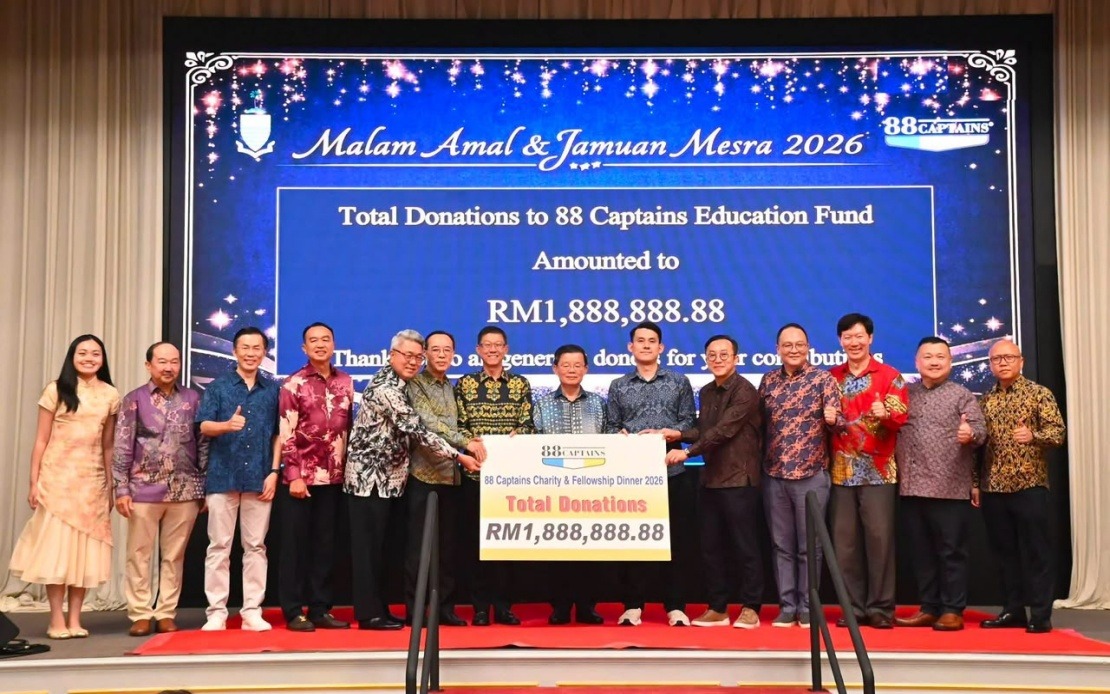
The Persatuan Kebajikan 88 Kapten Pulau Pinang has made a significant commitment to education in the northern region by awarding scholarships exceeding RM1 million to 44 students from five educational institutions. The initiative, unveiled at the organisation's annual charity dinner in George Town last month, reflects a growing concern among Malaysian business leaders about closing the widening gap between what universities produce and what employers actually need in the modern workforce.
Datuk Seri Dr Ooi Eng Hock, the organisation's chairman, framed the scholarship scheme not merely as a financial relief mechanism but as an investment in character and values. His emphasis on fostering ambition, resilience, and social responsibility among beneficiaries underscores a philosophical shift in how Malaysia's philanthropic sector approaches education—moving beyond simple poverty alleviation toward cultivating a generation equipped with both technical competence and ethical grounding. This nuanced approach aligns with emerging concerns among educators and policymakers that Malaysia's education system, while producing academically capable graduates, sometimes fails to develop the soft skills and civic consciousness that employers and society increasingly demand.
Central to 88 Captains' strategy is the Apprenticeship, Internship, Reskilling and Upskilling (AIRU) programme, launched last year at Universiti Sains Malaysia. This initiative represents a structured attempt to bridge the notorious theory-practice divide that has long plagued Malaysian higher education. By establishing a dedicated task force comprising outstanding scholars from USM, ViTrox College, Tunku Abdul Rahman University of Management and Technology, and INTI International University, the organisation is creating a mechanism through which student voices can directly influence curriculum and career preparation at multiple institutions simultaneously.
The creation of the 88 Captain Young Fellowship, tasked with engaging corporate leaders and founders, addresses a fundamental communication breakdown in the Malaysian education ecosystem. Graduates entering the workforce often discover that their qualifications, whilst academically sound, do not align with industry expectations regarding soft skills, technical depth in relevant domains, or understanding of workplace culture. By facilitating dialogue between CEOs and university scholars, this initiative seeks to make these expectations transparent long before students graduate, allowing institutions to adjust their programmes accordingly. The explicit mention of a RM4,000 minimum starting salary expectation for graduates provides concrete data that universities can use to calibrate their offerings.
The success of the recent charity dinner, which raised RM1.89 million with attendance from Penang Governor Tun Ramli Ngah Talib and Chief Minister Chow Kon Yeow, indicates substantial institutional and political backing for 88 Captains' agenda. This level of official endorsement suggests that education and talent development have become central concerns within Penang's administration, reflecting recognition that the state's future prosperity depends on cultivating human capital competitive with other regional economies.
Over its four-year operational history, 88 Captains has pursued a multifaceted approach to educational development extending beyond scholarships. The distribution of smart televisions to schools, establishment of 5G Education Digital Libraries across 88 schools, and support for the Special Education Integration Programme demonstrate a systematic attempt to democratise access to learning resources and ensure inclusion. These initiatives are particularly significant in Malaysia's context, where digital divides between urban and rural areas remain pronounced, and where students with special needs have historically faced marginalisation in the mainstream education system.
Chow Kon Yeow's remarks positioning the AIRU programme within Penang's broader economic strategy—specifically its ambitions in advanced manufacturing, semiconductors, artificial intelligence, and the digital economy—reveal how education initiatives connect to state-level competitiveness. Penang's historical strength in electronics manufacturing faces pressures from higher-wage competitors and automation. By ensuring that local graduates possess skills aligned with emerging high-value sectors, the state increases its ability to retain and attract investment in knowledge-intensive industries. This represents strategic thinking about human capital as a regional economic asset.
The launch of the Joint Mental Health Development in Schools with AI Early Education for Responsible Adoption initiative carries particular resonance following Malaysia's introduction of the Anti-Bullying Act 2026. Mental health challenges among Malaysian students have intensified in recent years, driven by academic pressure, social media dynamics, and post-pandemic adjustment difficulties. By explicitly linking mental health support with AI literacy and responsible technology adoption, 88 Captains acknowledges that contemporary student wellbeing cannot be addressed through traditional pastoral care alone—it requires understanding the technological environments in which young people increasingly operate. The initiative's emphasis on equipping teachers represents recognition that educational staff need sustained professional development to identify and address emerging mental health challenges linked to digital platforms.
Chow's statement that legal frameworks alone cannot prevent bullying and that prevention requires coordinated effort across schools, families, and communities reflects mature understanding of social problems' complexity. 88 Captains' willingness to contribute expertise and resources to this multi-stakeholder challenge demonstrates how the philanthropic sector can complement government action. This collaborative approach, increasingly common in developed economies, remains relatively nascent in Malaysia and suggests evolving sophistication in how social problems are tackled.
The organisation's founding in 2022 positioned it to respond quickly to post-pandemic challenges in education and employment. The timing proved fortuitous, allowing 88 Captains to address disruptions to learning continuity, rising graduate unemployment, and emerging skills mismatches before these became entrenched problems. Its focus on Penang and the northern region provides a geographic concentration that facilitates deeper impact than dispersed national efforts might achieve.
For Malaysian readers and policymakers, 88 Captains' model offers instructive lessons about translating philanthropic resources into systemic educational improvement. Rather than treating charity and education as distinct domains, the organisation integrates them, using financial support as a gateway to deeper involvement in curriculum alignment, skills development, and institutional partnerships. The explicit engagement with industry expectations and the commitment to mental health alongside academic support suggest a holistic understanding of what contemporary talent development requires.
Looking forward, the question for similar organisations throughout Malaysia becomes whether they can replicate 88 Captains' integrated approach while addressing regional variations in educational infrastructure and labour market demands. The initiative's success in Penang, a relatively well-resourced state with strong industrial bases, may face different constraints elsewhere. Nonetheless, the underlying philosophy—that education should serve both individual development and regional economic competitiveness, that industry and academia must communicate more effectively, and that talent development encompasses mental health and character alongside technical skills—offers a framework applicable across Malaysia's diverse contexts.

