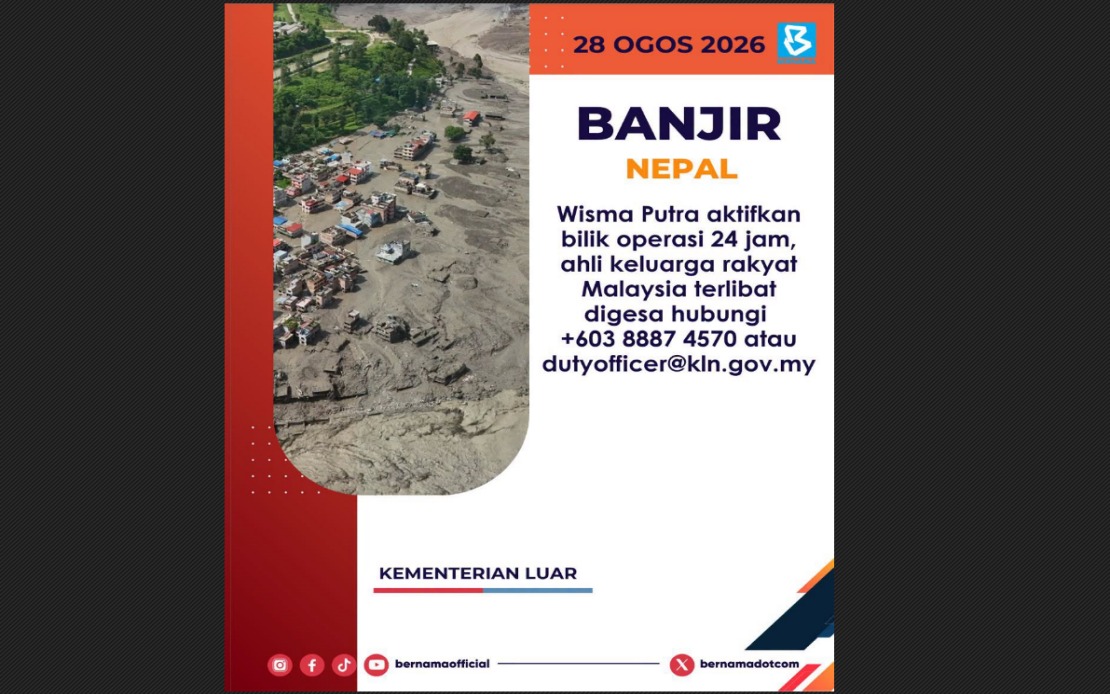
Malaysia's diplomatic apparatus has shifted into high alert following the devastating flash floods that struck Nepal's Rasuwa district, with Wisma Putra confirming that 57 Malaysian nationals have lost contact with their families and employers in the wake of the disaster. The Foreign Ministry's Operations Room in Putrajaya is now functioning around the clock, representing an escalation in the government's response to what has emerged as a significant challenge for Malaysian nationals caught in the region during one of Nepal's worst natural disasters in recent years.
The precise number of missing Malaysians was compiled from reports filed by concerned relatives, acquaintances, and employers as communications became increasingly fragmented across the affected zones. As of late evening on 27 August, when Wisma Putra released its statement, the foreign ministry acknowledged that the situation remained fluid and potentially subject to revision as more information emerged from the field. This uncertainty underscores the communication blackout affecting the disaster zone, where infrastructure destruction has severely hampered both rescue efforts and the ability of authorities to establish a comprehensive picture of casualties and missing persons.
What distinguishes Malaysia's response has been the systematic coordination between multiple stakeholder groups operating under diplomatic protocols. Malaysian diplomatic missions throughout the region are engaged in meticulous cross-referencing of reported missing persons against data being compiled by Nepalese authorities and local emergency agencies. This collaborative approach also involves engagement with Nepal's Foreign Ministry Emergency Response Team and the Nepal Tourism Board, reflecting recognition that many Malaysian nationals in the region are tourists rather than permanent residents. The emphasis on verification rather than mere accumulation of figures reflects diplomatic best practice in high-stakes emergency situations where false reports can misdirect resources and create additional anxiety among families.
A significant complication has emerged from the geographical complexity of the situation. Wisma Putra has received credible reports suggesting that some Malaysian nationals may have crossed into Nepal's disaster zone from neighbouring countries, particularly through transit points in China and India. This trans-border mobility creates additional verification challenges, as individuals who entered Nepal via alternative routes may not be listed on conventional arrival records maintained at primary border checkpoints. Consequently, the ministry has made a public appeal for any Malaysians who travelled through the wider regional network and have yet to formally register their presence to come forward with identifying documentation and location information.
For families coordinating the search for missing relatives, Wisma Putra has established multiple channels of communication to centralise reporting and investigation efforts. The Operations Room maintains direct telephone contact at +603 8887 4570, while the duty officer email address [email protected] accepts detailed submissions containing passport numbers, full names, travel itineraries, last confirmed locations, and contact numbers. Additionally, Malaysia's Embassy in Kathmandu has been designated as a secondary reporting point, with families encouraged to send information to [email protected] while simultaneously copying the Operations Room. This redundancy in communication pathways reflects institutional recognition that some channels may become overwhelmed, and maintaining parallel systems ensures no critical information is lost through bottlenecks.
The magnitude of the underlying crisis has continued to deepen as casualty figures from Nepal mounted through the week. Official reports indicated that the flash flooding, which struck Wednesday morning, had claimed over 400 lives with more than 800 people unaccounted for across the affected region. The composition of the missing includes hundreds of foreign tourists, suggesting that the disaster has struck during a period of significant international tourism activity in Nepal. For Malaysia specifically, the reliance on tourism-based travel patterns means many nationals in the affected areas lack established institutional frameworks like embassy contacts or formal residency registrations that would typically facilitate rapid identification and communication.
The physical devastation wrought by the flooding has created profound logistical obstacles for rescue operations and the restoration of communication infrastructure. Roads serving the affected zones have been rendered impassable by debris, landslides, and water damage, forcing authorities to rely extensively on helicopter-based transport for both rescue missions and medical evacuations. This dependency on air operations significantly constrains the pace at which missing persons can be located and extracted. Medical prioritisation protocols have been implemented whereby individuals requiring urgent intervention are airlifted directly to major hospitals in Kathmandu, while those sustaining minor injuries receive treatment through field medical camps established within accessible portions of the affected district.
The humanitarian dimension extends beyond the immediate rescue phase into questions of welfare and diaspora support. Malaysian nationals residing permanently in Nepal face distinct challenges compared to tourists, as their established residence patterns and social networks may have been disrupted by the flooding. Some may have lost employment, accommodation, or access to essential services. Wisma Putra's encouragement for all Malaysians in the region, whether residing there or in transit, to register through the e-Konsular online portal addresses this comprehensively, creating a persistent record that survives communication outages and enables the ministry to maintain contact across fluid situations.
From a regional perspective, this incident illustrates the vulnerability of Southeast Asian nationals to major natural disasters in South Asian tourism and transit zones. Nepal's critical role as a trekking and tourism destination means substantial Malaysian populations concentrate in specific geographic areas during peak seasons, creating potential for significant casualty clusters during major geological or meteorological events. The coordination mechanisms now being deployed by Wisma Putra will likely set precedents for future cross-border emergency responses, particularly given the frequency with which Southeast Asian tourists encounter hazardous weather in Nepal and adjacent Himalayan regions.
The 24-hour operational posture adopted by Wisma Putra signals the seriousness with which the Malaysian government is treating both the immediate missing persons situation and the broader welfare of its nationals in the affected region. This commitment of resources and personnel reflects established protocol for Level One humanitarian crises affecting citizens abroad. For families awaiting word of relatives, the round-the-clock availability of the Operations Room provides at least a formal point of contact for channelling information and coordinating search efforts, though the fundamental constraints imposed by the physical disaster—communication blackouts, limited helicopter capacity, and ongoing weather hazards—mean that resolution of individual cases will necessarily be protracted. Officials have advised all Malaysians still in or near the affected zones to maintain heightened vigilance, prioritise personal safety above all other considerations, and comply fully with instructions issued by local Nepalese authorities, acknowledging that secondary hazards including further flooding and landslides continue to threaten the region.

