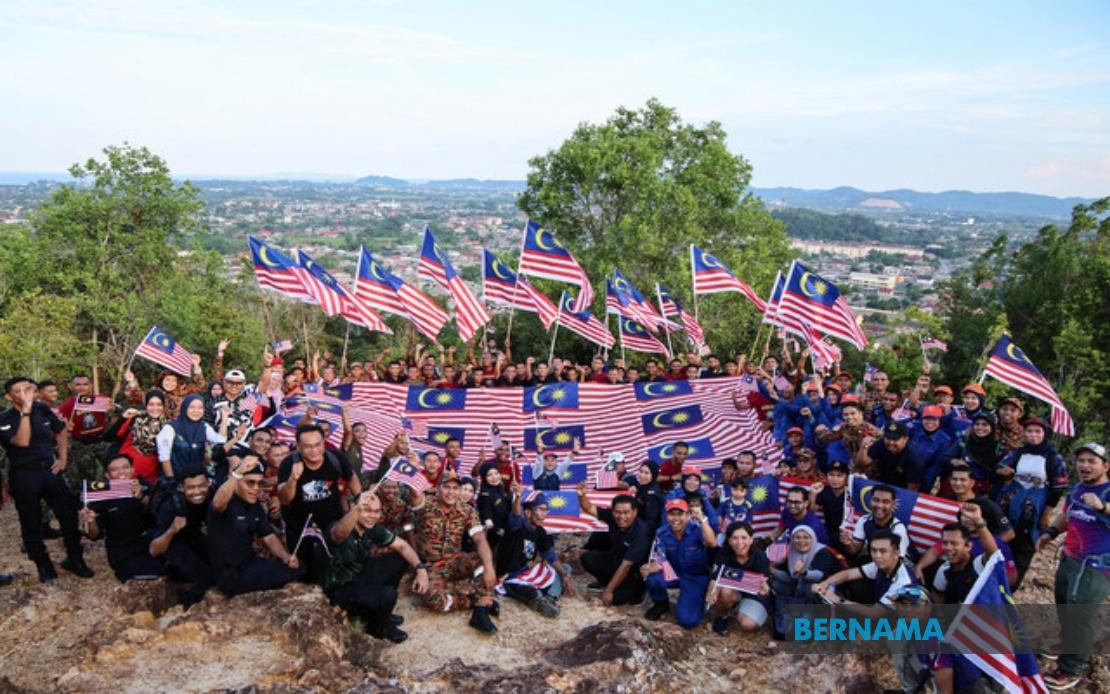
An inaugural summit trek organized by the Media and Communications Association drew 300 participants across Terengganu's security and government landscape, blending patriotic observance with professional networking on August 21. The event assembled representatives from multiple agencies, creating an unusual gathering that reflected how Malaysia's institutional sectors are leveraging the National Month period for both symbolic and practical purposes. Participants included personnel from the Terengganu Fire and Rescue Department, Malaysian Armed Forces, Road Transport Department, Malaysian Anti-Corruption Commission, the state's Ministry of Domestic Trade and Cost of Living, Royal Malaysian Customs Department, and Malaysia Civil Defence Force, alongside media practitioners who coordinated the initiative.
The expedition was conceived as more than a ceremonial outing. METRA president Mohd Zaid Mohd Noor articulated that the summit climb represented a deliberate statement about patriotism, intended to reach a climactic moment at the peak where organizers would unfurl a giant national symbol. This staging—ascending a physical elevation while marking the nation's founding period—translated abstract notions of love for country into tangible, shared experience. For media personnel particularly, the event embodied what organizers saw as professional responsibility: translating patriotic sentiment into accessible communication messages that could resonate across diverse platforms and audiences.
What distinguishes this Terengganu initiative from routine National Month activities is its structural emphasis on cross-sector participation and inter-agency relationship cultivation. Rather than organizing separate celebrations within institutional silos, the association deliberately orchestrated a scenario where uniformed personnel, civilian administrators, and communications professionals moved toward a common objective. This approach acknowledges an underlying reality in Malaysian governance: the effectiveness of public service delivery depends heavily on coordination between entities that often operate in parallel. By creating a physical and symbolic space where these groups converge, organizers introduced informal channels for relationship-building that formal meetings alone may not facilitate.
The health and wellness dimension woven into the event's messaging reflects broader regional trends toward integrating lifestyle promotion with civic engagement. Rather than framing patriotism as purely ideological or ceremonial, the summit trek positioned it within a context of personal wellbeing and physical fitness. This resonates with Malaysian policy initiatives emphasizing preventative health and active citizenship, particularly relevant given that many government and security sector personnel manage demanding schedules that often compromise exercise routines. By coupling patriotic observance with athletic activity, organizers made participation simultaneously an expression of national pride and an investment in personal health.
Terengganu's positioning as the venue carries its own significance. As a state navigating political transitions and seeking to strengthen its institutional profile, hosting such gatherings allows local government and security apparatus to demonstrate cohesion and dynamism. For a state like Terengganu, establishing visible examples of inter-agency cooperation carries value in projecting administrative competence to both residents and the federal center. The August timing—during the National Month—offered a ready framework and audience attention that individual agencies might struggle to generate independently.
The media practitioners' role in organizing the expedition underscores evolving relationships between journalism and state institutions in Malaysia. Rather than maintaining traditional distance, METRA positioned the media association as an active facilitator of civic messaging and institutional connectivity. This raises questions about editorial independence and the boundaries between advocacy and journalism, yet it also reflects practical recognition that media organizations possess platforms and convening power that can serve broader public communication objectives during significant national periods.
Froms Southeast Asian perspective, this kind of event reflects wider patterns of how nations in the region leverage ceremonial and symbolic activities to reinforce institutional relationships and national cohesion. Thailand, Indonesia, and other regional states similarly employ National Month and patriotic occasions to organize multi-sector gatherings that simultaneously serve communication, morale-building, and administrative purposes. In Malaysia's context, where communal harmony and institutional effectiveness are persistent policy priorities, such events offer low-cost mechanisms for periodic relationship maintenance across bureaucratic hierarchies.
The success of this inaugural trek likely influences how Terengganu and possibly other states approach future National Month programming. If the event achieved its stated objectives—strengthening ties while elevating patriotic spirit—expect similar initiatives to proliferate. Government agencies increasingly recognize that standing ceremonies alone fail to engage younger personnel or general publics effectively. Events combining physical activity, patriotic symbolism, and informal networking appeal to modern preferences for experiential engagement over passive observation.
Looking forward, the outcome of this Terengganu experiment may shape how Malaysian public institutions think about institutional culture and inter-agency relations. If the summit trek catalyzes measurable improvements in coordination between participating agencies—whether through informal networks established during the climb or renewed commitment to collaborative initiatives—it justifies replication elsewhere. Conversely, if the event remains a one-off ceremonial moment without concrete follow-through, it may exemplify the challenge of translating symbolic patriotic gestures into sustained institutional change, a pattern familiar across many Asian governance contexts where grand ceremonies occasionally mask limited bureaucratic reform.

