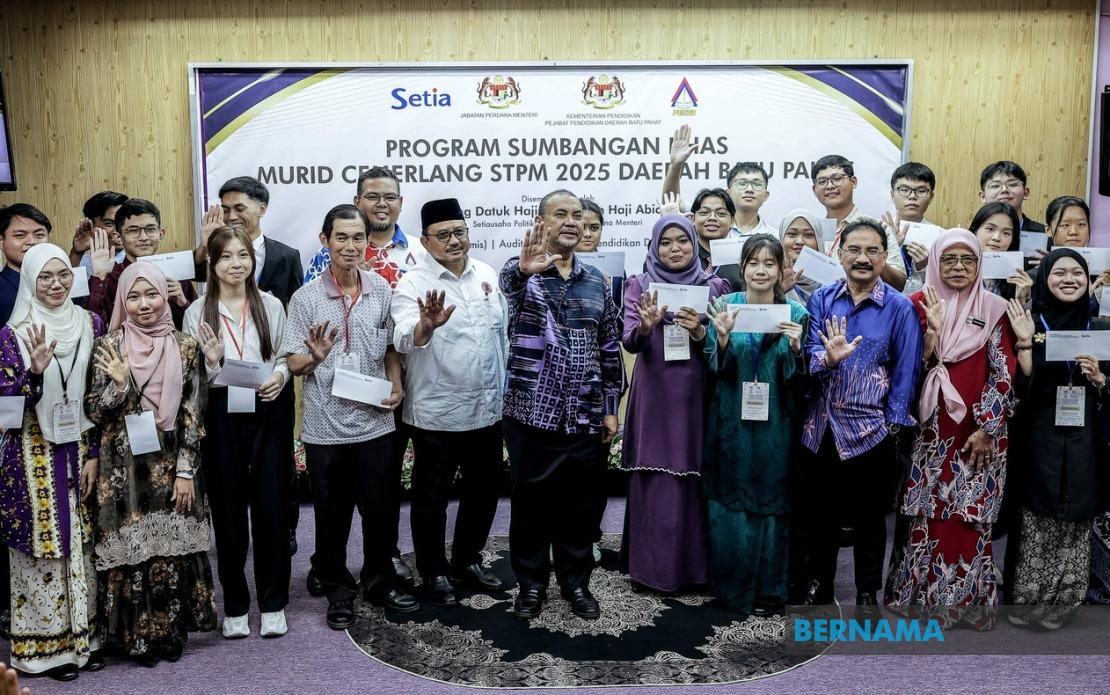
A total of 214 outstanding students who achieved excellence in the 2025 Sijil Tinggi Persekolahan Malaysia examination have received special monetary contributions from the Prime Minister's Office in Batu Pahat, marking a significant recognition of their academic accomplishments. The awards were distributed at a ceremony held at the Batu Pahat District Education Office auditorium, bringing together high achievers from 16 secondary schools across the district. This initiative underscores the government's commitment to identifying and supporting Malaysia's most academically gifted students at the crucial pre-tertiary stage of their educational journey.
Datak Azman Abidin, Political Secretary to the Prime Minister, explained that the contribution scheme operates as both a recognition mechanism and a motivational tool for recipients to maintain their academic standards while pursuing further studies. The programme reflects a broader governmental strategy to ensure that excellence in education is publicly acknowledged and rewarded, particularly at a formative stage when students are making critical decisions about their tertiary education pathways. By extending this recognition across multiple schools within a single district, the initiative aims to create a culture of achievement and academic aspiration among the student population.
According to Azman, the government intends to sustain this recognition programme in future years, contingent upon the availability of dedicated funding. Officials have signalled ambitions to expand the scheme beyond Batu Pahat to other districts and regions across Malaysia, potentially creating a nationwide framework for acknowledging top STPM performers. This expansion would require securing additional budget allocations and establishing systematic processes for identifying and verifying eligible recipients across multiple jurisdictions, representing a meaningful commitment to resource allocation in the education sector.
The contributions serve as tangible evidence of governmental support for the education sector and students' endeavours, positioning the recognition as more than merely symbolic. Azman emphasised that the awards represent the government's effort to demonstrate care and commitment towards educational empowerment, acknowledging student achievements, and facilitating their transition to higher learning. This messaging is particularly significant in the Malaysian context, where government support for education is closely scrutinised and education policy features prominently in public discourse about national development and social mobility.
Among the recipients was Afida Auni Airulnizam, a 20-year-old former student of Sekolah Menengah Kebangsaan Tun Sardon in Rengit, who expressed genuine gratitude for the recognition. She described the contribution as meaningful validation of her academic efforts and as significant encouragement to continue pursuing her educational goals at the tertiary level. Being the younger of two siblings, Afida draws inspiration from her older brother's university experience and aspires to follow a similar trajectory, with particular interest in sports science as a potential field of study should she gain admission to a relevant programme.
Afida's perspective on the award highlights how such recognition resonates with recipients beyond the financial aspect. The psychological dimension of public acknowledgement—having one's efforts formally recognised by high-level governmental structures—can substantially reinforce educational commitment during a period when students face considerable pressure and uncertainty about their futures. For students from middle and lower-income households, such contributions simultaneously address practical financial constraints whilst validating their academic worth, combining material and emotional support.
Muhd Ammar Firdaus Mohd Fadzil, also 20 years old and a former student of SMK Tun Ismail, similarly welcomed the initiative whilst highlighting a different dimension of its value. He pointed out that the financial contribution meaningfully eases the practical burden of preparing for higher education, addressing genuine concerns that many Malaysian families face regarding the costs associated with university entrance preparation, application processes, and the initial expenses of tertiary study. For students without family networks in higher education or substantial financial reserves, such support can prove instrumental in determining whether they proceed to university or pursue alternative pathways.
The awards encompassing students from 16 secondary schools across Batu Pahat demonstrate a deliberate effort to distribute recognition across the district's educational institutions rather than concentrating it in a handful of high-performing schools. This approach sends a message that excellence exists across the broader student population and encourages schools with varying academic reputations to foster high-achieving cohorts. It also reinforces the principle that geographic location should not determine access to recognition or support, an important consideration in Malaysia's context of educational equity across urban and suburban areas.
Batu Pahat, located in Johor state, represents a district with significant economic activity and a substantial student population navigating the competitive STPM examination system. The district's inclusion in this recognition programme reflects the broader national importance attached to identifying and nurturing high-achieving students at secondary level, particularly those completing the STPM qualification, which serves as the primary gateway to Malaysian public universities and increasingly to international tertiary institutions. The STPM pathway remains crucial for students planning university education, and recognition of top performers helps sustain motivation and commitment to rigorous academic standards.
From a policy perspective, this awards initiative reflects growing recognition that financial barriers and lack of institutional recognition can deter capable students from pursuing higher education, even when they demonstrate the academic ability to succeed. By combining financial contribution with formal public acknowledgement, the programme addresses multiple dimensions of student motivation and support. The emphasis on expanding the scheme to other locations suggests that policymakers view such targeted interventions as worthwhile investments in human capital development and educational outcomes.
The timing of the awards ceremony also matters contextually, as 2025 STPM graduates are currently navigating the transition toward tertiary education decisions and applications. Providing both financial and psychological support at this juncture helps stabilise students' confidence and removes certain barriers that might otherwise compromise their pursuit of higher education. For Malaysia's economic development trajectory, ensuring that high-achieving students progress to tertiary education and completing their degrees strengthens the pipeline of skilled professionals across critical sectors.
Looking forward, the success of this initial 214-student award cohort will likely inform decisions about programme expansion and refinement. Officials will presumably track whether recipients successfully progress to tertiary education, perform well in their chosen fields, and potentially become advocates for continued educational investment. Such data would be valuable for assessing the programme's effectiveness and justifying future funding allocations. As Malaysia continues to prioritise education as a strategic national priority, recognition schemes that combine financial support with institutional validation offer practical mechanisms for translating policy commitments into tangible student benefits.

