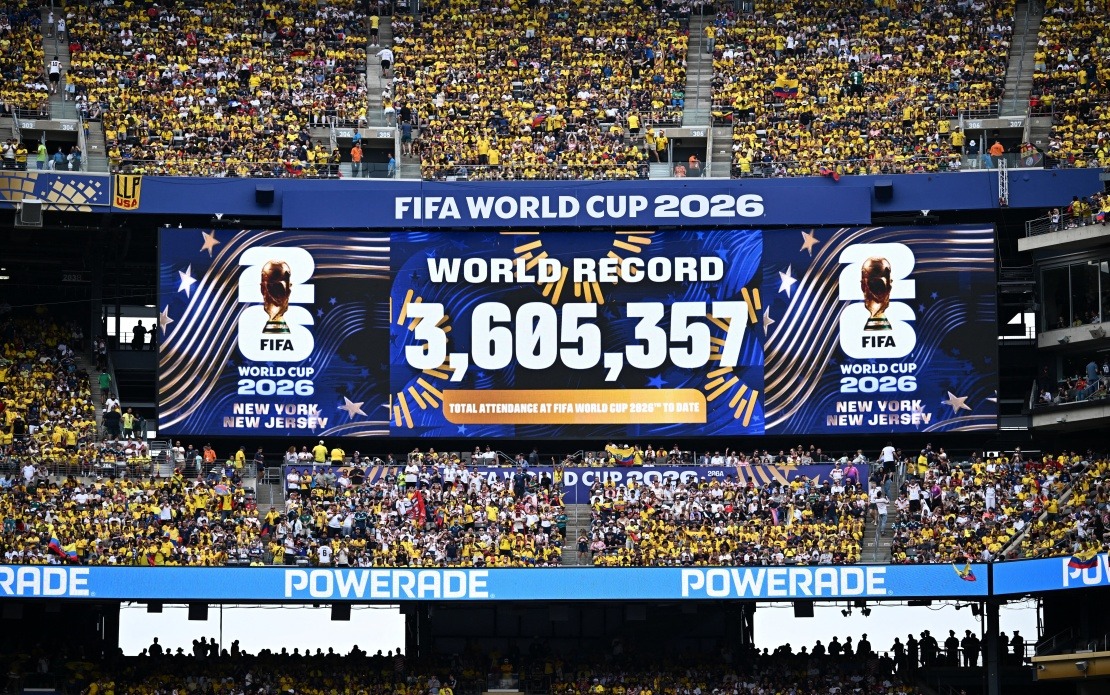
Football's global appeal reached a remarkable crescendo on Thursday when the 2026 World Cup officially became the most-watched tournament in the sport's history. The milestone was announced during Germany's match against Ecuador in East Rutherford, New Jersey, as the attendance figure of 3,605,357 lit up stadium screens to thunderous applause. This achievement demolishes the previous record set 32 years ago when the United States hosted the 1994 World Cup, which drew nearly 3.6 million spectators across its entire calendar.
The timing of the announcement—broadcast live to supporters in the stadium—underscores the monumental nature of the accomplishment for football enthusiasts worldwide. The display on giant screens transformed a routine moment in a group-stage fixture into an instant of sporting history, with the crowd's reaction capturing the genuine enthusiasm that has characterised this tournament across North America. For Malaysian football fans and the broader Southeast Asian region, the record reflects how World Cups have evolved into continental celebrations that transcend traditional football strongholds, drawing unprecedented numbers even in markets where the sport competes with indigenous leisure activities.
What renders this achievement even more significant is the substantial volume of matches still pending completion. With 48 encounters remaining on the fixture list, organisers and FIFA officials project that final attendance could approach double the 1994 figure, a feat once considered virtually impossible in tournament planning. This projection carries profound implications for how future World Cup hosts—including any potential Southeast Asian venues—will conceptualise stadium requirements and infrastructure development. The numbers suggest that contemporary infrastructure, transport networks, and hospitality offerings across the 16 host cities have successfully accommodated the enormous demand, setting a benchmark for future tournaments.
The consistency of attendance across venues demonstrates that enthusiasm has not concentrated in traditional football cities but rather spread evenly throughout the tournament's geographic footprint. Official data reveals that stadiums across all venues have maintained more than 99 percent capacity utilisation on average, a remarkable statistic that reflects unprecedented demand for tickets and access. This near-perfect occupancy rate suggests that pricing strategies, scheduling, and promotional efforts have resonated with both domestic and international audiences, creating an almost universal appetite for live football across the 16 host cities.
FIFA President Gianni Infantino characterised the record-breaking attendance as vindication of football's universal appeal and its unparalleled capacity to unite diverse populations in celebration. In his comments, Infantino emphasised that the exceptional scenes witnessed throughout the tournament's venues and across the 16 host communities represent something transcending mere sporting entertainment. The record speaks to football's role as a genuine cultural phenomenon capable of drawing families, communities, and nations together in shared moments of passion and collective experience.
For Malaysian and Southeast Asian stakeholders observing the tournament's success, the attendance surge carries instructive lessons about infrastructure investment and event management. The 2026 World Cup has vindicated the decision by tournament organisers to distribute matches widely rather than concentrating them in a handful of marquee stadiums. This distributed approach not only generated broader economic benefits across multiple regions but also democratised access for supporters living outside traditional metropolitan centres, a model that could inform future continental tournaments in Asia.
The comparative scale between the 1994 and 2026 tournaments further illuminates how football's reach has expanded over three decades. The earlier edition featured only 52 matches across 24 national teams, whereas the expanded 2026 format accommodates 48 teams competing in a 104-match schedule—a structural change that alone explains much of the attendance differential. However, the enthusiasm evident in the 99-percent-capacity average demonstrates that expansion has not diluted fan interest; rather, it has tapped into previously unrealised demand across geographies and demographics traditionally underserved by international football championships.
Stadium operators and local authorities across the 16 host cities have evidently executed complex logistical operations with considerable success. Transport infrastructure, hospitality services, security arrangements, and crowd management systems have absorbed the volume of foot traffic without apparent disruption, suggesting that investment in preparation has yielded tangible returns. For Malaysian cities evaluating potential bids for continental tournaments, the 2026 World Cup's operational success provides a detailed case study in how modern stadium and transport infrastructure can accommodate unprecedented demand.
The geographic distribution of hosting—spanning from established football markets to regions where the sport holds secondary cultural status—appears to have catalysed interest among populations less frequently engaged by international tournaments. This broadening of the audience base has profound implications for football's commercial trajectory and for how broadcasting networks, sponsors, and tournament organisers will structure future competitions to maximise reach and engagement across diverse regional markets.
As the tournament progresses toward its conclusion, the final attendance figure will likely establish a record so commanding that it will define tournament planning discussions for the foreseeable future. The 2026 World Cup has demonstrated conclusively that appetite for live football transcends traditional geographic and cultural boundaries, a reality that will shape how FIFA and continental confederations approach future expansions and structural modifications to international competitions. For emerging markets in Southeast Asia contemplating World Cup hosting, the message is unambiguous: properly executed, a World Cup can draw audiences at scales previously thought implausible, transforming economic and cultural trajectories across entire regions.

